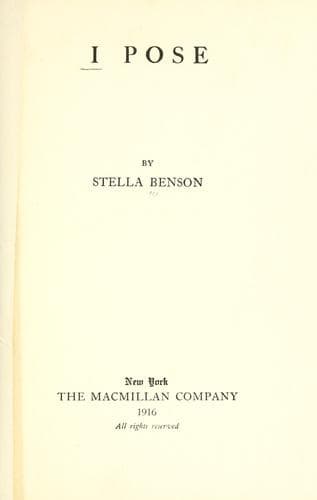
London (England) -- Fiction; Satire; Suffragists -- Fiction
They both shook hands in rather an absent-minded way with Mr. Samuel
Rust. They started from the door with the wind behind them. It was with
her hair blowing forward along her cheeks that the gardener always
remembered the suffragette most vividly. It brought a brave idea to his
mind, connected vaguely with a picture of Grace Darling with which he
had been in love fifteen years ago.
“Gardener,” said the suffragette hurriedly. “Can you imagine me sitting
by the fire bathing a baby?”
“Easily,” he replied. “I can imagine how the firelight would dance upon
your hair.”
“That doesn’t sound like me at all,” she said, with a catch in her
voice. “Can you imagine me, looking sleepy and cross, giving you early
breakfast before you went to work?”
“I can imagine you with the sun behind you, saying good-morning, so that
the word seemed like a blessing through the day.”
“It’s a lie—you poet,” she said. “Why don’t you open your eyes and see
me as I am?”
“I’ve had my eyes open all along. It’s you who are blind.”
“Then—suppose we become both lovers and friends.... Suppose we get
married on Tuesday....”
To-morrow I will don my cloak
Of opal-grey, and I will stand
Where the palm shadows stride like smoke
Across the dazzle of the sand.
To-morrow I will throw this blind
Blind whiteness from my soul away,
And pluck this blackness from my mind,
And only leave the medium—grey.
To-morrow I will cry for gains
Upon the blue and brazen sky:
The precious venom in my veins
To-morrow will be parched and dry.
To-morrow it shall be my goal
To throw myself away from me,
To lose the outline of my soul
Against the greyness of the sea.
CHAPTER II
The suffragette went up to London on Monday—Bank Holiday—to contemplate
finally the ruin of her work. For it was dead. I suppose if she had not
felt so old and tired she might have thought of a fresh beginning, but
she was always more passionate than persistent.
I don’t think the Brown Borough ever made her suffer so much as it did
the day she came back to it and found no place for her. You must
remember she had always put work before pleasure, and a new joy born had
no place in her mind with the pain of work killed. The gardener of
yesterday retreated from the foreground of her mind, and for a while she
never thought at all of the gardener of to-morrow.
Henceforward we part company with that suffragette whom I have loved
perhaps a good deal, and of whom you have wearied. Her heart seemed to
take on a different colour as she returned for the last time to the
Brown Borough. What she had preached for years conquered her beyond hope
at last, the world she had fought became suddenly victor.
She went to Jenny Wigsky, and found her gone.
Public-domain text, read in full here on John Shaqi.
Reviews
Reviews
No reviews yet
Be the first to share your thoughts on this work.
Elsewhere in the archive
Join the Discussion
Join the discussion
Sign in to leave a comment or review.
Sign InorCreate an account