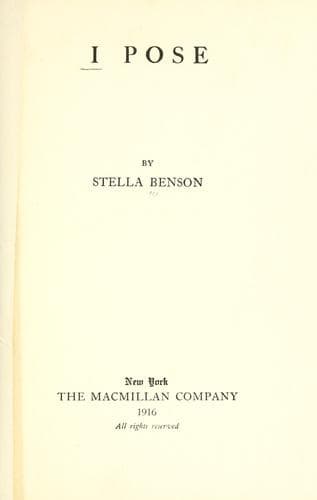
London (England) -- Fiction; Satire; Suffragists -- Fiction
He found the suffragette, looking sad, playing a forlorn game of
solitaire in forlorn surroundings in the little hotel sitting-room. With
her hat off she looked not so ugly, but more insignificant. Her hair
seemed as if it would never decide whether to be fair or dark until
greyness overtook it and settled the question. It had been tidied under
protest, and already strands of it were creeping over her ears, like
deserters leaving a fortress by stealth.
The room was papered and ceiled and upholstered in drab, there were also
drab photographs of unlovable bygones on the walls, and some drab
artificial flowers in a drab pot on the table.
There are some colour schemes that kill romance. Directly the gardener
felt the loveless air of the place, he plunged headlong into the cold
interview. Like a bather who, on feeling the chill of the sea, hastens
desperately to throw it around him from head to foot.
“I have been telling lies,” said the gardener.
“I have been crying,” said the suffragette.
They each thought that it was thoughtless of the other to be so
egotistical at this juncture. There is nothing that kills an effect so
infallibly as a collision in conversation.
“I have been telling lies,” said the gardener, “about you.”
“I have been crying—about you.”
(These women....)
The gardener took a deep breath, recoiled for a start, and ran upon his
subject.
“I have told them that you are my wife, and that you are coming with me
on the _Caribbeania_, sailing to-morrow morning for Trinity Islands.”
“Told who ... _Caribbeania_ ... Trinity Islands ...” gathered the
suffragette, with a woman’s instinct for tripping over the least
essential point. And then she interviewed herself laboriously on the
subject.
There was ample motive for a militant protest, and that was a
comfortable thought. She was justified in throwing any article of the
drab furniture at the gardener’s sharp and doubtful face. This creature
had put himself in authority over her without the authority to do so; he
had decided to lead her to Trinity Islands, whereas her life’s work lay
in England. This cold and curious boy had twisted off its hinges the
destiny of an independent woman. She had hitherto closed the door of her
heart against to-morrow. She had momentarily liked the idea of having a
friend who loved the shape of her face, especially as he was leaving the
country to-morrow. The unconventionality of the friendship had crowned
as an ornament a life of dreadful refinement. She had meant to step for
a moment from the lonely path, and now she found that her way back was
barred—by this impenetrable trifle. It was infuriating. But the
suffragette searched in vain for a trace of real fury in her heart. She
tested the power of words.
“It is infuriating,” she said.
“Yes,” said the gardener, not apologetically. “I quite see that.”
But she did not see it herself—except in theory.
Public-domain text, read in full here on John Shaqi.
Reviews
Reviews
No reviews yet
Be the first to share your thoughts on this work.
Join the Discussion
Join the discussion
Sign in to leave a comment or review.
Sign InorCreate an account