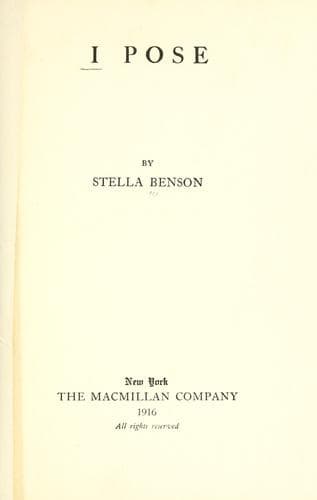
London (England) -- Fiction; Satire; Suffragists -- Fiction
The suffragette, who was under the impression that her hand was against
all men, stood bleakly on the port side, looking at the hydro-aeroplanes
leaping self-consciously about the Solent in seven-league boots. She was
proud to stand thus aloof and unhampered on the threshold of a novelty.
The pride she had in her independence was one of her compensations. This
is a world of compensations, and that is what makes it the hollow world
it is sometimes. So seldom do we get the real thing that in this age we
congratulate ourselves upon our compensations.
Mr. Samuel Rust made a late and dramatic appearance upon the gangway
after the first bell of preparation for departure had been rung. His
hat, inspired by the prevalent aviation craze, blew away. But Mr. Rust’s
thoughts were occupied with other things than the infidelity of hats. He
passed the gardener without noticing him, and with restrained fervour
addressed a square elderly woman, who stood leisurely on the deck,
surrounded by an officious maid, like a liner being attended to by a
tug.
Mr. Samuel Rust did not seem like the sort of person who would have had
a mother. He gave the impression of having been created exactly as he
stood, with one stroke of the Almighty Finger, and not gradually evolved
like you or me. You could imagine the gardener, for instance, at every
stage of his existence. You could picture those light bright eyes under
those scowling brows looking out of lace and baby-ribbons in a proud
nurse’s arms. You could see him as the fierce little schoolboy, with
alternately too much to say and too little. You could imagine him as an
old man, with that thick hair turned into a white strong flame upon his
head, and those already deep-set eyes blazing out of hewn hollows above
his abrupt cheek-bones. But Mr. Samuel Rust seemed to have no past and
no future.
He addressed the woman who, contrary to appearances, had played an
important part in the creating of him.
“I couldn’t let you go without saying good-bye to you, Mrs. Paul,” he
said.
“Of course you couldn’t,” said Mrs. Rust, and the words seemed shot by
iron lips from above a chin like a ship’s ram.
Something that might have usurped the name of a kiss passed between
them, and Mr. Samuel hurried to the impatient gangway. As he passed the
gardener he winked earnestly, conscious of his mother’s eyes on the back
of his head. The gardener, feeling delightfully unscrupulous and
roguish, made no sign.
The vulgarly tuneful swan-songs of Cockney emotion trailed from the deck
to the wharf and back again. The sound was like thin beaten silver,
becoming thinner as the distance increased. There were tears among the
women on land, and the shivering water blurred the reflections of the
crowd until they looked as though they were seen through tears. The last
song fainted in the air, the crowd on the wharf ceased to be human, and
became a long suggestion of many colours, a-quiver with waving
handkerchiefs.
Public-domain text, read in full here on John Shaqi.
Reviews
Reviews
No reviews yet
Be the first to share your thoughts on this work.
Join the Discussion
Join the discussion
Sign in to leave a comment or review.
Sign InorCreate an account