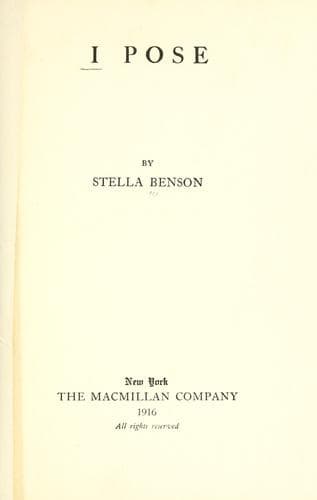
London (England) -- Fiction; Satire; Suffragists -- Fiction
“We can give you one,” said the lady, and took his portmanteau. She
could have given him several, but not one worth having. She conducted
him through one or two doors that led from the living-room. Each showed
a less attractive bedroom than the one before, but the cheapest was
barely within the range of prudence, as far as the gardener’s pocket was
concerned. In a leaden voice, proceeding from a heart of lead, he
concluded a bargain for the temporary possession of the least inviting.
And when it was done, and the portmanteau deposited drearily in the
middle of a dirty linoleum floor, he discovered that time had been
standing still, and that it was hardly nearer five o’clock than before.
It was the first time he had realised the four thousand miles that lay
between him and the kindly grey pavements of Penny Street. He remembered
the look of the London lamps reflected in the slaty mirrors of London
streets ... the smile of the ridiculous little griffin who sits on a
pedestal at the top of Fleet Street, playing the ’cello with his
shield ... the shrugging shoulders of St. Paul’s on tiptoe on the peak
of Ludgate Hill ... the dead leaves blowing down the Broad Walk, in the
rain....
There is no pose that saves you from that awful longing for the things
that are no longer yours, and which you hated while you possessed.
“I said I was enough for myself. And I am not,” said the gardener, and
hid his face in the mosquito net.
Strange things in barbaric colours made the garden outside a whirlpool.
Sometimes these things say to you: “You are a very long way from home”;
and you exult, and think This is Life. But sometimes they say again:
“You are a very long way from home”; and you cry out, and think This is
Worse than Death.
Now there are moral drawbacks about the posing habit. But there are also
advantages, though possibly none deserved. For after three minutes of
despair the gardener straightened himself, blinked, and began putting
his spare shirt into a drawer that would not shut. He was posing as One
Who was Seeing Life, and who was Making the Best of it. The vision that
inspired this brave pose was the ghost of a pair of small haggard eyes,
set in a short pointed face, eyes that cried easily and never
surrendered. A thin unbeautiful ghost with clenched fists, and in the
air, the ghost of a low and militant voice.
“I am not enough,” the gardener admitted. “But together, we are enough.”
He whistled a comic song tentatively. The Englishman never whistles or
sings to suit his feelings. He dies to the tune of “Tipperary,” or goes
to his wedding humming the “Dead March in Saul.”
Public-domain text, read in full here on John Shaqi.
Reviews
Reviews
No reviews yet
Be the first to share your thoughts on this work.
Join the Discussion
Join the discussion
Sign in to leave a comment or review.
Sign InorCreate an account