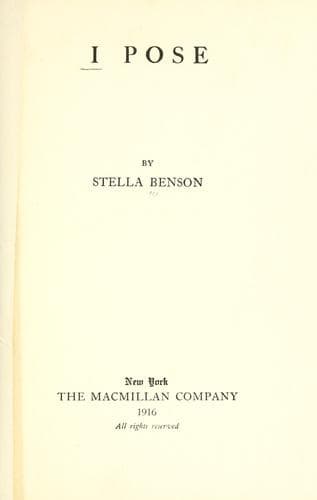
London (England) -- Fiction; Satire; Suffragists -- Fiction
“How curious of you!” she said. “You are perfectly right. Votes for
women!”
“Tra-la-la ...” sang the gardener wittily.
(You need not be afraid. There is not going to be so very much about the
cause in this book.)
They walked some way in silence. The gardener, of course, shared the
views of all decent men on this subject. One may virtuously destroy life
in a good cause, but to destroy property is a heinous crime, whatever
its motive.
(Yes, I know that made you tremble, but there are not many more
paragraphs of it.)
Presently they passed a car, pillowed against a grassy bank. Its
attitude, which looked depressed, was not the result of a catastrophe,
but of a picnic. In the meadow, among the buttercups, could be seen four
female hats leaning together over a little square meal set forth in the
grass.
“Look,” said the suffragette, in a voice thin with scorn.
The gardener looked, but could see nothing that aroused in him a horror
proportionate to his companion’s tone.
“Listen,” said the suffragette half an octave higher.
The gardener listened. But all he heard was, “Oh, my dear, it was too
killing....”
Then, because the chauffeur on the bank paused in mid-sandwich, as if
about to rebuke their curiosity, they walked on.
“One is born a woman,” said the suffragette. “A woman in her
sphere—which is the home. One starts by thinking of one’s dolls, later
one thinks about one’s looks, and later still about one’s clothes. But
nobody marries one. And then one finds that one’s sphere—which is the
home—has been a prison all along. Has it ever struck you that the
tragedy of a woman’s life is that she has time to think—she can think
and organise her sphere at the same time. Her work never lets her get
away from herself. I tell you I have cried with disgust at the sound of
my own name—I won’t give it to you, but it might as well be Jane Brown.
I have gasped appalled at the banality of my Sunday hat. Yet I kept
house excellently. And now I have run away, I am living a wide and
gorgeous life of unwomanliness. I am trying to share your simplest
privilege—the privilege you were born to through no merit of your own,
you silly little boy—the privilege of having interests as wide as the
world if you like, and of thinking to some purpose about England’s
affairs. My England. Are you any Englisher than I?”
“You are becoming incoherent,” said the gardener. “You are enjoying a
privilege which you do not share with me—the privilege of becoming
hysterical in public and yet being protected by the law. You are a
woman, and goodness knows that is privilege enough. It covers everything
except politics. Also you have wandered from the point, which at one
time appeared to be a picnic.”
(Courage. There is only a little more of this. But you must allow the
woman the privilege of the last word. It is always more dignified to
allow her what she is perfectly certain to take in any case.)
Public-domain text, read in full here on John Shaqi.
Reviews
Reviews
No reviews yet
Be the first to share your thoughts on this work.
Join the Discussion
Join the discussion
Sign in to leave a comment or review.
Sign InorCreate an account