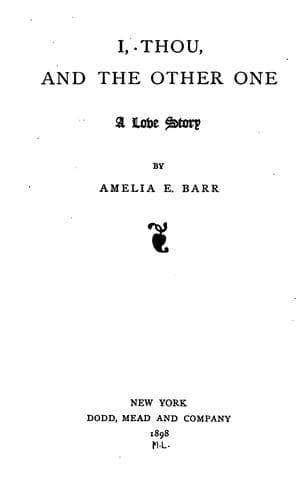
I, Thou, and the Other One: A Love StoryBarr, Amelia E.
General
I, Thou, and the Other One: A Love Story
Barr, Amelia E.
Fiction; Love stories
The conversation having drifted to Edgar and Reform, stayed there.
Lord Exham spoke with a polite, but stubborn emphasis in favour of his
own caste, as the governing caste, and thought that the honour and
welfare of England might still be left "to those great Houses which
represented the collective wisdom of the nation." Nor was he disturbed
when Mrs. Atheling, with some scorn and temper, said "they represented
mostly the collective folly of the nation." He bowed and smiled at
the dictum, but Kate understood the smile; it was of that peculiarly
sweet kind which is equivalent to having the last word. He admitted
that some things wanted changing, but he said, "Changes could not be
manufactured; they must grow." "True," replied Kate, "but Reform
has been growing for sixty years." "That is as it should be," he
continued. "You cannot write Reforms on human beings, as you write it on
paper. Two or three generations are not enough." In all that was
said--and Mrs. Atheling said some very strong things--he took a polite
interest; but he made no surrender. Even if his words were conciliatory,
Kate saw in his eyes--languid but obstinately masterful--the stubborn,
headstrong will of a man who had inherited his prejudices, and who had
considered them in the light of his interest, and did not choose to bring
them to the light of reason.
Still the conversation was a satisfactory and delightful vehicle of human
revelation. The two women paled and flushed, and grew sad or happy in
its possibilities, with a charming frankness. No social subject could
have revealed them so completely; and Exham enjoyed the disclosures of
feeling which this passionate interest evoked,--enjoyed it so much that
he forgot the lapse of time, and stayed till tea was ready, and then was
delighted to stay and take it with them. Mrs. Atheling was usually
relieved of the duty of making it by Kate; and Piers could not keep his
glowing eyes off the girl as her hands moved about the exquisite Derby
teacups, and handed him the sweet, refreshing drink. She remembered
that he loved sugar; that he did not love cream; that he preferred his
toast not buttered; that he liked apricot jelly; and he was charmed and
astonished at these proofs of remembrance, so much so indeed that he
permitted Mrs. Atheling to appropriate the whole argument. For this sweet
hour he resigned his heart to be pleased and happy. Too wise in some
things, not wise enough in others, Piers Exham had at least one great
compensating quality--the courage to be happy.
Public-domain text, read in full here on John Shaqi.
Reviews
Reviews
No reviews yet
Be the first to share your thoughts on this work.
Join the Discussion
Join the discussion
Sign in to leave a comment or review.
Sign InorCreate an account