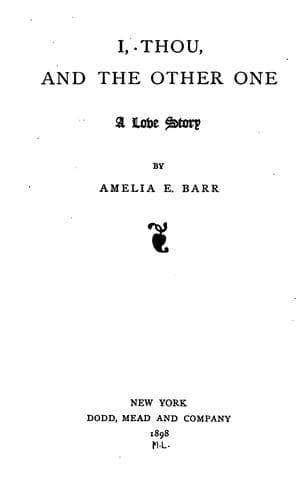
I, Thou, and the Other One: A Love StoryBarr, Amelia E.
General
I, Thou, and the Other One: A Love Story
Barr, Amelia E.
Fiction; Love stories
Such divided opinions were in every household; and yet, upon the
whole, the death of the selfish, intolerant George was a hopeful
event. When people are desperate, any change is a promise; and William
had a reputation not only for good nature, but also for that love of
fair play which is the first article of an Englishman's personal
creed. He came to the throne on the twenty-sixth of June; and on the
twenty-ninth Parliament resumed its sittings. Mr. Brougham led the
opposition, and violent debates and unmeasured language distinguished
the short session. The Duke of Wellington, representing the Government,
was prominently bitter against Reform of every kind; and Mr. Brougham
boldly declared that any Minister now hoping to rule either by royal
favour or military power would be overwhelmed. In less than a month
the King prorogued Parliament in person, and in so doing, congratulated
his country on the tranquillity of Europe. Forty-eight hours afterwards,
France was insurgent, and Paris in arms. Three days of most determined
fighting followed; and then Charles the Tenth was driven from his
throne, and the white flag of the Bourbon tyranny gave place to the
Tri-colour of Liberty.
Now if there had been a direct electric or magnetic current between
England and the Continent, the effect could not have been more
sympathetically startling; and these three memorable "Days of
July" in Paris impelled forward, with an irresistible impetus, the
cause of freedom in England. The nobility and the landed gentry were
gravely aware of this effect; and the great middle class, and the
working men in every county, were stirred to more hopeful and united
action. Far and wide the people began anew to express, in various
ways, their determination to have the Tory Ministers dismissed, and a
Liberal Government in favour of Reform inaugurated.
For the first time the Squire was anxious. For the first time he saw
and felt positive symptoms of insubordination among his own people.
Pickering's barns were burnt one night; and a few nights afterwards,
Rudby's hay-ricks. Squire Atheling was a man of prompt action; one
well disposed to do in his own manor what he expected the Government
to do in the country,--take the Reform bull by the horns. He sent for
all his labourers to meet him in the farm court at Atheling; and when
they were gathered there, he stood up on the stone wall which enclosed
one side of it and said in his strong, resonant voice,--
"Now, men of Atheling manor and village, you have been sulky and ugly
for two or three weeks. You aren't sulky and ugly without knowing _why_
you are so. If you are Yorkshiremen worth your bread and bacon, you will
out with your grievance--whatever it is. Tom Gisburn, what is it?"
"We can't starve any longer, Squire. We want two shillings a week more
wages. Me and mine would hev been in t' churchyard if thy Missis hed
been as hard-hearted as thysen."
"I will give you all one shilling a week more."
Public-domain text, read in full here on John Shaqi.
Reviews
Reviews
No reviews yet
Be the first to share your thoughts on this work.
Join the Discussion
Join the discussion
Sign in to leave a comment or review.
Sign InorCreate an account