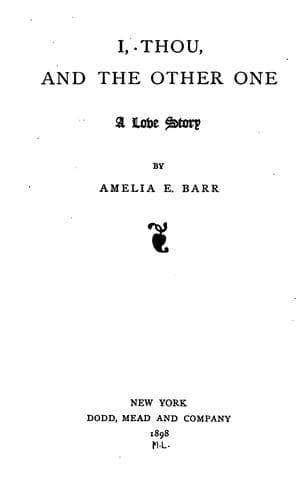
I, Thou, and the Other One: A Love StoryBarr, Amelia E.
General
I, Thou, and the Other One: A Love Story
Barr, Amelia E.
Fiction; Love stories
"That we do. We want the big towns, where working men are the many, and
rich men, the few, to be represented. We want all sham boroughs thrown
out. What do you think of Old Sarum sending a member to Parliament,
when there isn't any Old Sarum? There used to be, in the days of King
Edward the First, but there is now no more left of it than there is of
the Tower of Babel. What do you think of the Member for Ludgershall
being not only the Member, but the _whole constituency_ of Ludgershall?
What do you think of Gatton having just seven voters, and sending
_two_ members to Parliament?"--then leaning forward, and with burning
looks drinking the wind of his own passionate speech--"What do you
think of _Leeds! Manchester! Birmingham! Sheffield!_ being _without
any representation_!"
"My lad," cried the Squire, "have not Leeds, Manchester, Birmingham,
Sheffield, done very well without representation?"
"Squire, a child may grow to a man without love and without care; but
he is a robbed and a wronged child, for all that."
"The Government knows better than thee what to do with big towns full of
unruly men and women."
"That is just the question. They are not represented, because they
are made up of the working population of England. But the working man
has not only his general rights, he has also rights peculiar to his
condition; and it is high time these rights were attended to. Yet these
great cities, full of woollen and cotton weavers, and of fine workers
in all kinds of metals, have not a man in Parliament to say a word for
them."
"What is there to say? What do they want Parliament to know?" asked the
Squire, scornfully.
"They want Parliament to know that they are being forced to work twelve
hours a day, for thirty pennies a week; and that they have to pay ten
pennies for every four-pound loaf of bread. And they expect that when
Parliament knows these two facts, something will be done to help them in
their poverty and misery. They believe that the people of England will
_compel_ Parliament to do something."
"There are Members in both Houses that know these things, why do they
not speak?--if it was reasonable to do so."
"Squire, they dare not. They have not the power, even if they had the
will. The Peers and the great Landlords own two-thirds of the House of
Commons. They _own_ their boroughs and members, just as they _own_ their
parks and cattle. One duke returns eleven members; another duke returns
nine members; and such a city as Manchester cannot return one! If this
state of things does not need reforming, I do not know what does."
So far his words had rushed rattling on one another, like the ring of
iron on iron in a day of old-world battle; but at this point, the Squire
managed again to interrupt them. From his saddle he had something of an
advantage, as he called out in an angry voice,--
"And pray now, what are _you_ to make by this business? Is it a bit of
brass--or land--or power that you look forward to?"
Public-domain text, read in full here on John Shaqi.
I, Thou, and the Other One: A Love Story — John Shaqi
Reviews
Reviews
No reviews yet
Be the first to share your thoughts on this work.
Join the Discussion
Join the discussion
Sign in to leave a comment or review.
Sign InorCreate an account