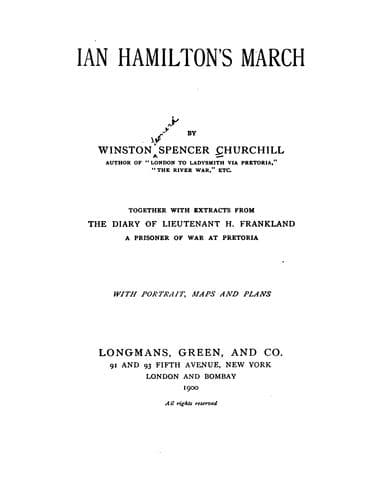
Hamilton, Ian, Sir, 1853-1947; South African War, 1899-1902
I will not for one moment dispute the wisdom or the justice of his
removal. In stormy weather one must trust to the man at the helm, and
when he is such a man as Lord Roberts it is not a very hard thing to do.
But because General Gatacre has been cruelly persecuted in England by
people quite ignorant of the difficulties of war or of the conditions
under which it is carried on in this country, it is perhaps not out of
place to write a few words of different tenor.
Gatacre was a man who made his way in the army, not through any
influence or favour which he enjoyed, but by sheer hard work and good
service. Wherever he had served he had left a high record behind him.
On the Indian frontier he gained the confidence of so fine a soldier as
Sir Bindon Blood, and it was largely to his reputation won in the
Chitral Expedition that his subsequent advancement was due. At Bombay
in 1897 he was entrusted with the duty of fighting the plague, then
first gripping its deadly fingers into the city. No one who is at all
acquainted with the course of this pest will need to be told how
excellent was his work. After the late Soudan campaign I travelled from
Bombay to Poona with a Parsee gentleman, a wealthy merchant of the
plague-stricken town, and I well remember how he dilated on the good
which Gatacre had done.
’He was our only chance,’ said the black man. ’Now he is gone, and the
sickness will stay for ever.’
Gatacre’s part in the Soudan campaign has been described at length
elsewhere. His courage has never been questioned, because the savage
critics did not wish to damage their cause by obvious absurdities. If I
were to discuss his tactics in the Boer war here I should soon get on to
ground which I have forbidden myself. It is sufficient to observe that
Gatacre retained the confidence and affection of his soldiers in the
most adverse circumstances. When the weary privates struggled back to
camp after the disastrous day at Stormburg they were quite clear on one
point: ’No one could have got us out but him.’ Two days before he was
dismissed the Cameron Highlanders passed through Bethany, and the men
recognised the impetuous leader of the Atbara charge; and, knowing he
had fallen among evil days, cheered him in the chivalry of the common
man. The poor general was much moved at this spontaneous greeting,
which is a very rare occurrence in our phlegmatic, well-ordered British
Army. Let us hope the sound will long ring in his ears, and, as it
were, light a bright lamp of memory in the chill and dreary evening of
life.
Public-domain text, read in full here on John Shaqi.
Reviews
Reviews
No reviews yet
Be the first to share your thoughts on this work.
Join the Discussion
Join the discussion
Sign in to leave a comment or review.
Sign InorCreate an account