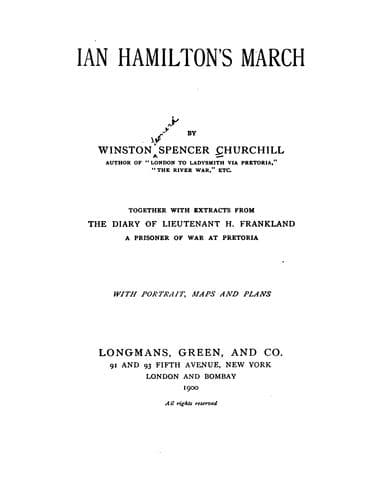
Hamilton, Ian, Sir, 1853-1947; South African War, 1899-1902
Beyond it, commanding it, essential to it, yet not of it, was a steep
rocky kopje. The swift advance and the necessity of pressing the enemy
had left the Infantry a long way behind. The General felt, however,
that this point must be secured. McNeill made a dash for it with the
scouts. The Yeomanry galloped off to the right again, as if about to
surround it, and the Boers allowed themselves to be bounced out of this
strong and important position, and scampered away to a smooth green hill
a mile in rear. Brabazon made haste to occupy the captured kopje in
force, and did so just in time, for as soon as the turning force--two
companies (I am going to call them squadrons in future) of yeomanry and
a company of Mounted Infantry--approached the green hill, the musketry
suddenly grew from an occasional drip into a regular patter, and there
was the loud boom of a field gun. We had found the main Boer position,
and the Cavalry came to a standstill. The enemy now directed a very
sharp fire on the captured kopje, which, it seems, they originally
intended to hold had they not been hustled out of it as has been
described. They also shelled the Yeomanry--who were continuing the flank
movement--rather heavily as they retired, inflicting some loss.
We had now to wait for the Infantry, and they lagged on the road. The
Boer fire began to take effect. Several soldiers were carried wounded
off the top of the hill--one poor fellow shot through both cheekbones.
Others had to lie where they were struck because it was not possible to
move them while the fire was so accurate.
On the reverse slope, however, there was good cover for man and horse.
Some of the men were engaged for the first time, and though their
behaviour was excellent, the General thought it necessary to walk along
the firing line and speak a few words here and there.
The Infantry still lagged on the road, but at about two o’clock Sir
Leslie Rundle himself arrived. The firing about the kopje had been
loud, and a rumour--who starts these tales?--ran back along the marching
columns that the Cavalry were hard pressed, were running short of
ammunition, and that the Boers were turning both flanks. At any rate, I
found anxious faces in the divisional staff.
Rundle considered that the retention of the kopje was of first
importance, and Sir Herbert Chermside, his second in command, fully
agreed with him. But the Infantry of the advanced guard were alone near
enough. It was decided to push them on. At this moment a reassuring
message arrived from Brabazon engaging that he could hold his own, and
hoping the Infantry would not be hurried so as to lose their breath.
Public-domain text, read in full here on John Shaqi.
Reviews
Reviews
No reviews yet
Be the first to share your thoughts on this work.
Join the Discussion
Join the discussion
Sign in to leave a comment or review.
Sign InorCreate an account