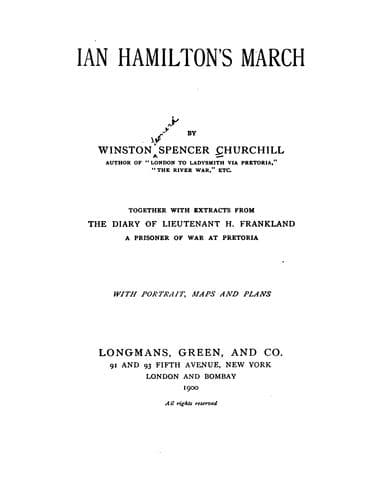
Hamilton, Ian, Sir, 1853-1947; South African War, 1899-1902
General Campbell, with three battalions (including two of her Majesty’s
Guards) and a battery, was marching to join the main column. It was
necessary, in view of the entrenchments and the approaching
reinforcements, to wait until the force was complete. The event would
be decided on the morrow, and meanwhile Brabazon and the mounted
troops--Cavalry, I shall call them--were to make a reconnaissance of the
Boer left.
The brigade, which included the Mounted Infantry, and was about a
thousand strong, moved southward behind the outpost line and, making a
rapid and wide circuit, soon came on the enemy’s left flank. Here we
waited while patrols were pushed out and while Brabazon was clearing his
own right by a still wider turning movement. The patrols soon drew the
fire of the Boer pickets, and the rifle shots began to ring out in the
clear cool air of the morning. Presently a party of a dozen Boers
appeared in the distance, galloping down towards a farm whence they
might fire on the gradually advancing Cavalry. The General asked the
subaltern in charge of our two guns whether they were within range. The
young officer was anxious to try. We watched the experiment with
attention.
The practice was extremely good. The first shell burst in the middle of
the Boer horsemen, who at once spread into a looser formation. The next
exploded in front of them, and all the seven shells that were fired fell
within measurable distance of someone.
For the first time in this war I saw the Boers show what I consider
cowardice; for without anyone being killed or wounded the whole party
turned back and, abandoning their intention or duty, scurried away to
cover behind the long swell of ground over which they had come. The
Boer Army in Natal was not thus easily dissuaded from its objects.
Meanwhile the flanking movement was in progress, and as the ground to
our right was gradually made good and secured by Colonel Sitwell,
Brabazon pushed his centre forward until McNeill’s scouts were cantering
all over the slopes where the Boers had just been shelled, and hunting
such of the enemy as tarried to safer and more remote positions. At
last we arrived at the edge of the swell of ground. It fell steeply
towards a flat basin, from the middle of which rose a most prominent and
peculiar kopje. Invisible behind this was Dewetsdorp. Round it stood
Boers, some mounted, some on foot, to the number of about two hundred.
Our rapid advance, almost into the heart of their position, had
disturbed and alarmed them. They were doubtful whether this was
reconnaissance or actual attack. They determined to make certain by
making an attempt to outflank the outflanking cavalry; and no sooner had
our long-range rifle fire compelled them to take cover behind the hill
than a new force, as it seemed, of two hundred rode into the open and
passing across our front at a distance of, perhaps, 2,000 yards, made
for a white stone kopje on our right.
Public-domain text, read in full here on John Shaqi.
Reviews
Reviews
No reviews yet
Be the first to share your thoughts on this work.
Join the Discussion
Join the discussion
Sign in to leave a comment or review.
Sign InorCreate an account