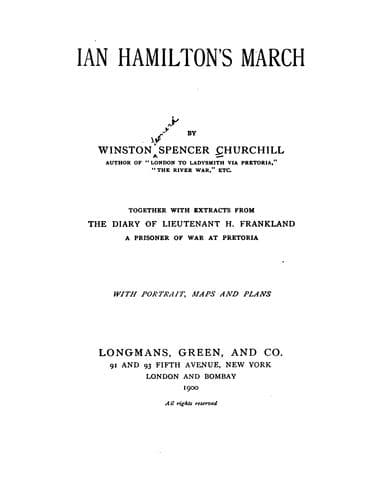
Hamilton, Ian, Sir, 1853-1947; South African War, 1899-1902
At Sterkstroom a line of empty trenches, the Red Cross flag over a
hospital, and an extension to the cemetery enclosure filled with brown
mounds which the grass had not yet had time to cover, showed that we had
crossed the line between peace and war. Passing through Molteno, the
last resting-place of the heroic de Montmorency, the train reached
Stormburg. Scarcely any traces of the Boer occupation were to be seen;
the marks of their encampments behind the ridge where they had
laagered--a litter of meat tins, straw, paper, and the like, the grave
of Commandant Swanepoole and several nameless heaps, a large stone (in
the station-master’s possession) with the words engraved on it: ’In
memory of the Transvaal commando, Stormburg, December 1899,’ and that
was all. The floods had abated and receded. This was the only jetsam
that remained.
At Stormburg I changed my mind, or, rather--for it comes to the same
thing and sounds better--I made it up.
I heard that no immediate advance from Bloemfontein was likely or even
possible for a fortnight. Therefore, I said, I will go to Capetown, and
shelter for a week at ’The Helot’s Rest.’ After all, what is the use of
a roving commission if one cannot rove at random or caprice?
So to Capetown I went accordingly--seven hundred miles in forty-eight
hours of bad trains over sections of the line only newly reopened. But
to Capetown I will not take the reader. Indeed, I strongly recommend
him to stick to the war and keep his attention at the front, for
Capetown at this present time is not an edifying place. Yet, since he
may be curious to know some reason for such advice, let me explain.
Capetown, which stands, as some writers have observed, beneath the
shadow of Table Mountain, has been--and may be again in times of
peace--a pleasant place in which to pursue business or health; but now
it is simply a centre of intrigue, scandal, falsehood, and rumour.
The visitor stays at the Mount Nelson Hotel, if he can be so fortunate
as to secure a room. At this establishment he finds all the luxuries of
a first-class European hotel without the resulting comfort. There is a
good dinner, but it is cold before it reaches him; there is a spacious
dining-room, but it is overcrowded; there are clean European waiters,
but they are few and far between.
At the hotel, in its garden, or elsewhere in the town, all the world and
his wife are residing--particularly the wife.
We used to think, in the Army of Natal, that Lord Roberts’s operations
in the Free State had been a model of military skill and knowledge, and,
in a simple way, we regarded French as one of the first cavalry soldiers
of the age.
Public-domain text, read in full here on John Shaqi.
Reviews
Reviews
No reviews yet
Be the first to share your thoughts on this work.
Join the Discussion
Join the discussion
Sign in to leave a comment or review.
Sign InorCreate an account