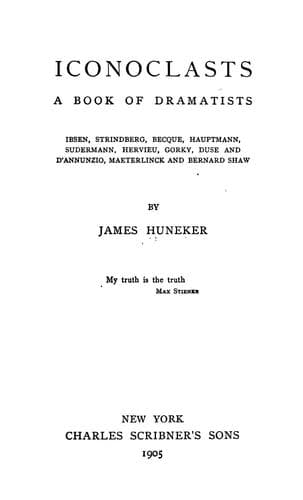
Iconoclasts: A Book of Dramatists: Ibsen, Strindberg, Becque, Hauptmann, Sudermann, Hervieu, Gorky, Duse and D'Annunzio, Maeterlinck and Bernard ShawHuneker, James
History
Iconoclasts: A Book of Dramatists: Ibsen, Strindberg, Becque, Hauptmann, Sudermann, Hervieu, Gorky, Duse and D'Annunzio, Maeterlinck and Bernard Shaw
Huneker, James
Dramatists; European drama -- 19th century -- History and criticism; European drama -- 20th century -- History and criticism
La Course du Flambeau played by Réjane with such striking effect is
judged by some of Hervieu's admirers as his masterpiece. It is not,
though an exceedingly interesting work replete with wisdom and several
strong studies of character. Sabine Revel, who sacrifices her mother
for the sake of her daughter and is in turn herself sacrificed,
illustrates the not uncommon fate of a selfish daughter and a too
fond mother. The Greek motto embodied in the title--the passing on of
the illuminated torch, according to Lucretius, at the "lampadophories"
festival in Athens--is employed by the dramatist as a symbol of the
chain of life, the light passed on from one generation to another with
the sacrificing of the old by the young which characterizes human
existence.
Yet there is no hint of Ibsen in this symbol; Hervieu is a painter of
manners, and a psychologist, not a poet. He confessed to me, while
graciously submitting to be "interviewed," that Ibsen has had little
part in his development. He is a true Frenchman and really derives
from Dumas _fils_ in his love of the problem posed; while his cerebral
temperament makes him more of a disciple of Stendhal and Becque than
of the very emotional, modern Germans and Scandinavians. Yet he has an
_emotive_ temperament--a glance at his sympathetic eyes will prove
it. He is a man with too large a head for his frame. He feels too
deeply to be happy. M. Alfred Binet, in his precise psychological study
of the dramatist, describes his sober methods of travail, his slow
composition, his philosopher's dislike of the hasty or the improvised,
and his fondness for clearly articulated dialogue. He has the logical
imagination, he disdains the Zola "human documents" in preparing his
story, and while he is by nature an ironist, he is too serious in his
outlook on life to play the part of a mystifier. "Irony is the speech
of the timid man," he said to me, when we spoke of Becque and his too
cynical disciples. An anxious sincerity is the key-note of M. Hervieu's
character. He abhors the facile triumphs of the Parisian play-maker who
dallies with ignoble themes. A finely attuned intellect, a plentiful
sympathy with suffering, a special sensitiveness to the soul feminine,
combined with real artistry,--though he despises mere technical
dexterity,--all have made Paul Hervieu the present master-psychologist
of the French stage.
VI
THE QUINTESSENCE OF SHAW
I
To my friend, George Bernard Shaw, the Celtic super-man,
critic, novelist, socialist, and preface writer, to whom
the present author--_circa_ 1890--played the part of a
critical finger-post for the everlasting benefit (he
sincerely hopes) of the great American public; and to
whom he now dedicates this particular essay in gratitude
for the rare and stimulating pleasure afforded him by the
Shaw masques, the Shavian philosophy, and also the vivid
remembrance of several personal encounters at London and
Bayreuth.
Public-domain text, read in full here on John Shaqi.
Reviews
Reviews
No reviews yet
Be the first to share your thoughts on this work.
Elsewhere in the archive
Join the Discussion
Join the discussion
Sign in to leave a comment or review.
Sign InorCreate an account