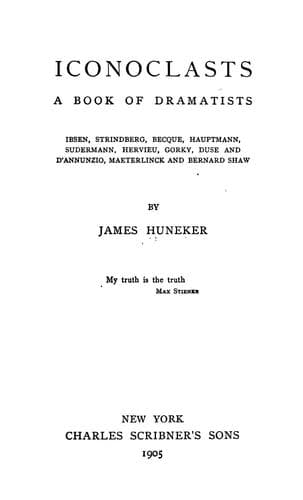
Iconoclasts: A Book of Dramatists: Ibsen, Strindberg, Becque, Hauptmann, Sudermann, Hervieu, Gorky, Duse and D'Annunzio, Maeterlinck and Bernard ShawHuneker, James
History
Iconoclasts: A Book of Dramatists: Ibsen, Strindberg, Becque, Hauptmann, Sudermann, Hervieu, Gorky, Duse and D'Annunzio, Maeterlinck and Bernard Shaw
Huneker, James
Dramatists; European drama -- 19th century -- History and criticism; European drama -- 20th century -- History and criticism
Ten years pass, when the curtain again rises. There is a child; the
home is seemingly a placid one. The little son must be sent to school.
Another crisis. There is a terrible duel of words and will. Enraged she
cries, "The child is not yours," and then confesses--no, confesses is
not the word, rather boasts, that she had a lover, the man she always
loved, the traveller. The husband now no longer claims the other's
son; he will even grant the divorce. The culmination comes when Irene
refuses to be thrust out of doors,--the child has just passed through
the room,--she has borne the agony of ten years. They must go hand in
hand manacled to the end, let the nippers gall as they will. There is
the child. Its future is at stake. "But," the man whimpers, "you are
guilty and I am innocent."--"No," she says, "we are only two miserable
people, and misery knows none but equals." The answer is like the harsh
stroke of a savage alarm bell. It startled all Paris for many months.
_Les paroles restent!_
The Law of Man is even more tense and disagreeable than its
predecessor. Herein the problem posed is this (for with Hervieu the
play is always a problem; like Ibsen he asks questions and seldom
answers them, though it may be premised that while he has much of
Ibsen's gloom and love for the unusual, he lacks the cold, concentrated
logic of the Norwegian): A woman surprises her husband by means of
letters, but does not leave him. Her daughter falls in love with the
son of the woman who has caused the trouble. Poor wife, poor mother,
she is confused at these crossroads of misery. Sacrifice her daughter
and appease her vengeance, or--hold her silence for evermore? She
prefers the former, and summoning the husband of her own husband's
mistress, the father of the young man who seeks the hand of her
innocent daughter, she tells the secret. After the first natural rage,
this undeceived man, more merciful than the woman, insists on her
silence. Two innocent young folk must not have their happiness slain
because of their parents' sins. And as it is his right, the selfish and
wretched woman must submit. A way is found to make the lovers happy,
and the play ends, leaving all sorts of interrogation marks in the air.
There are big things in this drama.
Public-domain text, read in full here on John Shaqi.
Reviews
Reviews
No reviews yet
Be the first to share your thoughts on this work.
Elsewhere in the archive
Join the Discussion
Join the discussion
Sign in to leave a comment or review.
Sign InorCreate an account