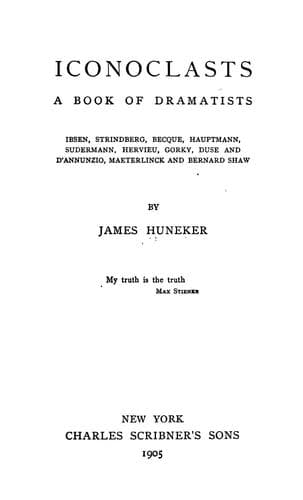
Iconoclasts: A Book of Dramatists: Ibsen, Strindberg, Becque, Hauptmann, Sudermann, Hervieu, Gorky, Duse and D'Annunzio, Maeterlinck and Bernard ShawHuneker, James
History
Iconoclasts: A Book of Dramatists: Ibsen, Strindberg, Becque, Hauptmann, Sudermann, Hervieu, Gorky, Duse and D'Annunzio, Maeterlinck and Bernard Shaw
Huneker, James
Dramatists; European drama -- 19th century -- History and criticism; European drama -- 20th century -- History and criticism
This book or tract--it is hardly a novel--contains among other
extraordinary things a eulogy of photography that would delight the
soul of a Steichen. Shaw places it far above painting because of its
verisimilitude! It also introduces a lot of socialistic talk which is
very unconvincing; the psycho-physiologist would really pronounce the
author a perfect specimen in full flowering of the saintly anarch.
There is a rôle played by a character--Shaw?--? which recalls Leonard
Charteris in a later play, The Philanderer. All of his men are modelled
off the same block. They are a curious combination of blackguard,
philosopher, "bounder," artist, and comedian. His women! Recall
Stevenson's dismayed exclamation at the Shaw women! They are creatures
who have read Ibsen; are, one is sure, dowdy; but they interest. While
you wonder at the strength of their souls, you do not miss the size
of their feet. Mr. Shaw refuses to see woman as a heroine. She is
sometimes a breeder of sinners, always a chronicler of the smallest
kind of small beer, and for fear this sounds like an I ago estimate, he
dowers her with an astounding intellectual equipment, and then lets the
curious compound work out its own salvation.
He is much more successful with his servants; witness Bashville in
Cashel Byron's Profession, most original of lackeys, and the tenderly
funny old waiter in You Never Can Tell, a bitter farce well sprinkled
with the Attic salt of irony. Otherwise Mr. Shaw has spent his time
tilting at flagellation, at capital punishment, at the abuse of
punctuation, at the cannibalistic habit of eating the flesh of harmless
animals at Christmas, at Going to Church, extolling Czolgosz--heavens!
the list is a league long. His novels as a whole are disappointing,
though George Meredith has assured us in the first chapter of Diana
that brain stuff in fiction is not lean stuff. But there are some
concessions to be made to the Great God Beauty, and these Mr. Shaw has
not seen fit to make. Episodes of brilliancy, force, audacity, there
are; but episodes only. The psychology of a musician is admirably set
forth in Love Among the Artists, and the story, in addition, contains
one of the most lifelike portraits of a Polish _pianiste_ that has
ever been painted. John Sargent could have done no better in laying
bare a soul. Ugliness is rampant--ugliness and brutality. It is all as
invigorating as a bath of salt water when the skin is peeled off--it
burns; you howl; Shaw grins. He hates with all the vigour of his big
brain and his big heart to hear of the infliction of physical pain. He
does not always spare his readers. Three hundred years ago he would
have roasted heretics, for there is much of the grand inquisitor, the
John Calvin, the John Knox, in Shaw. He will rob himself of his last
copper to give you food, and he will belabour you with words that
assault the tympanum if you disagree with him on the subject of Ibsen,
Wagner, or--anything he likes.
Public-domain text, read in full here on John Shaqi.
Reviews
Reviews
No reviews yet
Be the first to share your thoughts on this work.
Elsewhere in the archive
Join the Discussion
Join the discussion
Sign in to leave a comment or review.
Sign InorCreate an account