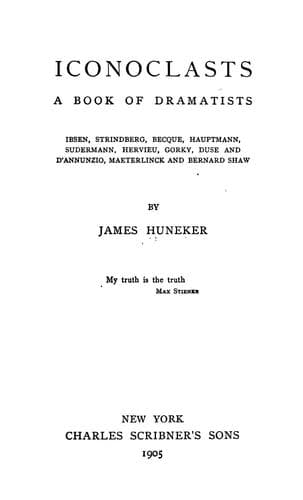
Iconoclasts: A Book of Dramatists: Ibsen, Strindberg, Becque, Hauptmann, Sudermann, Hervieu, Gorky, Duse and D'Annunzio, Maeterlinck and Bernard ShawHuneker, James
History
Iconoclasts: A Book of Dramatists: Ibsen, Strindberg, Becque, Hauptmann, Sudermann, Hervieu, Gorky, Duse and D'Annunzio, Maeterlinck and Bernard Shaw
Huneker, James
Dramatists; European drama -- 19th century -- History and criticism; European drama -- 20th century -- History and criticism
Beefsteak, old Scotch ale, a pipe, and Montaigne--are what he needs
for one year. Then his inhumane criticism of poor, stumbling mankind's
foibles might be tempered. Shaw despises weakness. He follows to
the letter Nietzsche's injunction, Be hard! And there is something
in him of Ibsen's pitiless attitude toward the majority, which is
always in the wrong; yet is, all said and done, the majority. Facts,
reality, truth--no Gradgrind ever demanded them more imperiously than
Heervater Shaw, whose red beard and locks remind one of Conrad in Die
Meistersinger. Earth folk do everything to dodge the facts of life,
to them cold, harsh, and at the same time fantastic. Every form of
anodyne, ethical, intellectual, æsthetical, is resorted to to deaden
the pain of reality. We work to forget to live; our religions, art,
philosophy, patriotism, are so many buffers between the soul of man and
bitter truth.
Shaw wants the truth at all hazards; his habit of veracity is like that
of Gregers's Werle, is shocking. So he dips his subjects into a bath
of muriatic acid and seems surprised at their wrigglings and their
screams. "But I don't want to hear the truth!" yells the victim, who
then limps back to his comfortable lies. And the one grievous error
is that our gallant slayer of dragons, our Celtic Siegfried, does not
believe in the illusions of art. Its veils, consoling and beautiful,
he will not have, and thus it is that his dramas are amusing, witty,
brilliant, scarefying, but never poetic, never beautiful, and seldom
sound the deeper tones of humanity. With an artist's brain, he stifles
the artist's soul in him--as Ibsen never did. With all his liberalism
he cannot be liberal to liberalism, as Gilbert Chesterton so neatly
puts it.
The Perfect Wagnerite and The Quintessence of Ibsenism are two
supernally clever _jeux d'esprit_. As he reads Shaw and Fabianism
into the Ring of the Nibelungs, so his Ibsen is transformed into a
magnified image of Shaw dropping ideas from on high with Olympian
indifference. This pamphlet, among the first of its kind in English,
now seems a trifle old-fashioned in its interpretation of the Norwegian
dramatist--possibly because he is something so different from what Mr.
Shaw pictured him. We are never shown Ibsen the artist, but always the
social reformer with an awful frown. He was a fighter for Ibsen, when
in London Ibsen was once regarded as a perverter of morals. Bravery is
Bernard's trump card. He never flinched yet, whether answering catcalls
from a first night's gallery or charging with pen lowered lance-fashion
upon some unfortunate clerical blockhead who endeavoured to prove that
hell is too good for sinners.
Public-domain text, read in full here on John Shaqi.
Reviews
Reviews
No reviews yet
Be the first to share your thoughts on this work.
Elsewhere in the archive
Join the Discussion
Join the discussion
Sign in to leave a comment or review.
Sign InorCreate an account