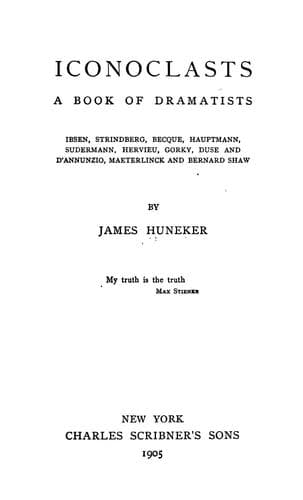
Iconoclasts: A Book of Dramatists: Ibsen, Strindberg, Becque, Hauptmann, Sudermann, Hervieu, Gorky, Duse and D'Annunzio, Maeterlinck and Bernard ShawHuneker, James
History
Iconoclasts: A Book of Dramatists: Ibsen, Strindberg, Becque, Hauptmann, Sudermann, Hervieu, Gorky, Duse and D'Annunzio, Maeterlinck and Bernard Shaw
Huneker, James
Dramatists; European drama -- 19th century -- History and criticism; European drama -- 20th century -- History and criticism
What does Mr. Shaw himself think of Candida? Perhaps if he could be
persuaded to tell the truth, the vapourish misconceptions concerning
her terrible "shawl" speech--about which I never deceived myself--might
be dissipated. It was not long forthcoming--his answer to my question,
an answer the publication of which was left to my discretion. It may
shock some of his admirers, disconcert others, but at the same time it
will clear the air of much cant; for there is the Candida cant as well
as the anti Shaw cant. He wrote me:--
Don't ask me conundrums about that very immoral female,
Candida. Observe the entry of W. Burgess: "You're the
lady as hused to typewrite for him." "No." "Naaaow: _she_
was younger." And therefore Candida sacked her. Prossy is
a very highly selected young person indeed, devoted to
Morell to the extent of helping in the kitchen but to him
the merest pet rabbit, unable to get the slightest hold
on him. Candida is as unscrupulous as Siegfried: Morell
himself sees that "no law will bind her." She seduces
Eugene just exactly as far as it is worth her while to
seduce him. She is a woman without "character" in the
conventional sense. Without brains and strength of mind
she would be a wretched slattern or voluptuary. She is
straight for natural reasons, not for conventional ethical
ones. Nothing can be more cold-bloodedly reasonable
than her farewell to Eugene: "All very well, my lad;
but I don't quite see myself at fifty with a husband of
thirty-five." It is just this freedom from emotional slop,
this unerring wisdom on the domestic plane, that makes her
so completely mistress of the situation.
Then consider the poet. She makes a man of him finally by
showing him his own strength--that David must do without
poor Uriah's wife. And then she pitches in her picture
of the home, the onions, and the tradesmen, and the
cossetting of big baby Morell. The New York _hausfrau_
thinks it a little paradise; but the poet rises up and
says, "Out then, into the night with me"--Tristan's
holynight. If this greasy fool's paradise is happiness,
then I give it to you with both hands, "life is nobler
than that." That is the "poet's secret." The young things
in front weep to see the poor boy going out lonely and
broken-hearted in the cold night to save the proprieties
of New England Puritanism; but he is really a god going
back to his heaven, proud, unspeakably contemptuous of
the "happiness" he envied in the days of his blindness,
clearly seeing that he has higher business on hand
than Candida. She has a little quaint intuition of the
completeness of his cure; she says, "he has learnt to do
without happiness."
Public-domain text, read in full here on John Shaqi.
Reviews
Reviews
No reviews yet
Be the first to share your thoughts on this work.
Elsewhere in the archive
Join the Discussion
Join the discussion
Sign in to leave a comment or review.
Sign InorCreate an account