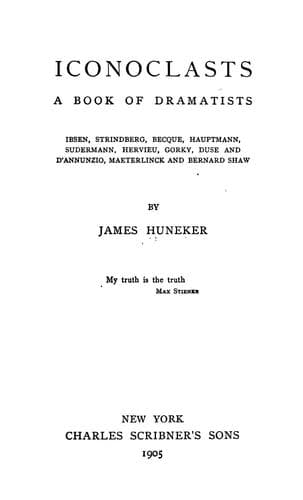
Iconoclasts: A Book of Dramatists: Ibsen, Strindberg, Becque, Hauptmann, Sudermann, Hervieu, Gorky, Duse and D'Annunzio, Maeterlinck and Bernard ShawHuneker, James
History
Iconoclasts: A Book of Dramatists: Ibsen, Strindberg, Becque, Hauptmann, Sudermann, Hervieu, Gorky, Duse and D'Annunzio, Maeterlinck and Bernard Shaw
Huneker, James
Dramatists; European drama -- 19th century -- History and criticism; European drama -- 20th century -- History and criticism
Therefore Candida is a large exposition of the doctrine that love
should be free,--which is by no means the same thing as free love; that
it should be a burden equally borne by both partners in the yoke; that
happiness, instead of misery, would result if more women resembled
Candida in candour. She cut James to the heart with the confounding
of her shawl and personal purity; it was an astounding idea for a
clergyman's ears. She proved to him later that she was right, that the
hundredth solitary sinner is of more consequence than the ninety-nine
reclaimed. Shaw, who is a Puritan by temperament, has, after his
master, Ibsen, cracked with his slingstone many nice little glass
houses wherein complacent men and women sit and sun their virtues in
the full gaze of the world. One of his sharp and disconcerting theories
is that woman, too, can go through the Venusberg and still reach the
heights--a fact always denied by the egotistical man, who wishes to be
the unique sinner so that he may receive the unique consolation. After
a gay life, a sober one; the reformed rake; Tannhäuser's return to an
Elizabeth, who awaits him patiently; dear, sweet, virtuous Penelope!
Shaw sees through this humbug of the masculine pose and turns the
tables by making his Candida ride the horse of the dilemma man-fashion.
Maeterlinck, in his Monna Vanna and Joyzelle, enforces the same
truth--that love to be love should be free.
And the paradoxical part of it all is that Candida is a womanly woman.
She is so domestic, so devoted, that the thin-skinned idealist Eugenie
moans over her kitchen propensities. Shaw has said that "the ideal wife
is one who does everything that the ideal husband likes, and nothing
else," which is a neat and sardonic definition of the womanly woman's
duty. Candida demands as her right her husband's trust in her love,
not heavenly rewards, not the consciousness of her own purity, not
bolts and bars will keep her from going from him if the hour strikes
the end of her affection. All of which is immensely disconcerting to
the orthodox of view, for it is the naked truth, set forth by a man
who despises not orthodoxy, but those who profess it only to practise
paganism. This Shaw is a terrible fellow; and the only way to get rid
of a terrible fellow is not to take him seriously but to call him
paradoxical, entertaining; to throw the sand of flattery in his eyes
and incidentally blind criticism at the same time. But Bernard Shaw has
always refused to be cajoled, and as to the sand or the mud of abuse
--well, he wears the very stout spectacles of common sense.
III
Public-domain text, read in full here on John Shaqi.
Reviews
Reviews
No reviews yet
Be the first to share your thoughts on this work.
Elsewhere in the archive
Join the Discussion
Join the discussion
Sign in to leave a comment or review.
Sign InorCreate an account