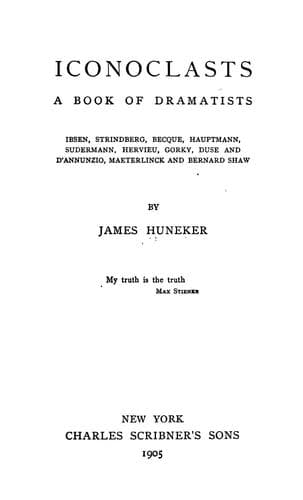
Iconoclasts: A Book of Dramatists: Ibsen, Strindberg, Becque, Hauptmann, Sudermann, Hervieu, Gorky, Duse and D'Annunzio, Maeterlinck and Bernard ShawHuneker, James
History
Iconoclasts: A Book of Dramatists: Ibsen, Strindberg, Becque, Hauptmann, Sudermann, Hervieu, Gorky, Duse and D'Annunzio, Maeterlinck and Bernard Shaw
Huneker, James
Dramatists; European drama -- 19th century -- History and criticism; European drama -- 20th century -- History and criticism
The first act is promising. Mr. Shaw's little paragraphs--they are
intended as a prompt-book in miniature--are more amusing than his
preface. We are deluded into the notion that a first-class comedy is at
hand. There are all the materials ready. Ramsden, an "advanced" thinker
of the antiquated Bradlaugh type, has been appointed co-executor,
co-guardian with Tanner, a thinker of the latter-day type; that is, a
man who has read Marx, Proudhon, Nietzsche, but not Max Stirner. The
fair Ann, her mother and sister are the stakes of the game. Octavius,
the sap-headed young man, is ready to sacrifice himself, and his sister
shocks all by not acknowledging the father of her unborn child. Here
is potential stuff for a tragic comedy. But Mr. Shaw will not mould his
material into viable shapes. He refuses to be an artist. He loathes
art. And so he is punished by fate--his inspiration vanishes almost at
the point of execution, and, except for a few fugitive flashes, never
burns serenely or continuously.
One telling bit is when Tanner congratulates Violet (what an
appropriate name!) on her delicate condition and is scorned by that
young person, scorned and snubbed. What--she a wicked woman! No, she
is but secretly wedded; in the fulness of time her husband will be
revealed. Tanner sneaks away, feeling that not to women must man look
for the emancipation of the sexes from conventional notions. There are
long harangues on prevailing economic evils, social diseases--all the
old Shaw grievances are paraded.
Act II is rather thin. In Act III, which recalls a Gilbertian farce,
there are cockney brigands, a bandit corporation, limited, devoted to
the robbing of automobiles that pass through Spain. The idea is not
sufficiently novel to be funny. A lengthy parabasis, written in genuine
Shavian, shows us hell, the Devil, Don Juan, and Anna of Mozartean
fame. At least the talk here is as brilliant as is commonly supposed to
prevail in the nether regions. _Inter alia,_ we read that marriage is
the most licentious of human institutions--hence its popularity. Even
the Devil is shocked. "The confusion of marriage with morality has done
more to destroy the conscience of the human race than any other single
error." "Beauty, purity, respectability, religion, art, patriotism,
bravery, and the rest are nothing but words which I or any one else
can turn inside out like a glove," continues this relentless rake and
transformed preacher. Too true; but the seamy side as exhibited by Don
Juan Shaw is not so convincing as in Nietzsche's transvaluation of
all values. "They are mere words, useful for duping barbarians into
adopting civilization, or the civilized poor into submitting to be
robbed and enslaved."
Public-domain text, read in full here on John Shaqi.
Iconoclasts: A Book of Dramatists: Ibsen, Strindberg, Becque, Hauptmann, Sudermann, Hervieu, Gorky, Duse and D'Annunzio, Maeterlinck and Bernard Shaw — John Shaqi
Reviews
Reviews
No reviews yet
Be the first to share your thoughts on this work.
Elsewhere in the archive
Join the Discussion
Join the discussion
Sign in to leave a comment or review.
Sign InorCreate an account