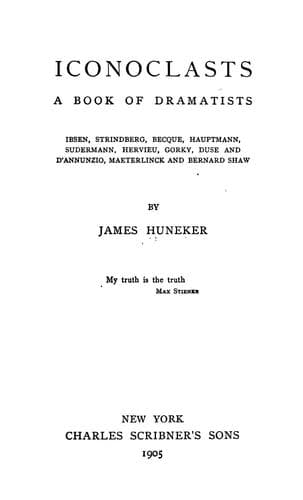
Iconoclasts: A Book of Dramatists: Ibsen, Strindberg, Becque, Hauptmann, Sudermann, Hervieu, Gorky, Duse and D'Annunzio, Maeterlinck and Bernard ShawHuneker, James
History
Iconoclasts: A Book of Dramatists: Ibsen, Strindberg, Becque, Hauptmann, Sudermann, Hervieu, Gorky, Duse and D'Annunzio, Maeterlinck and Bernard Shaw
Huneker, James
Dramatists; European drama -- 19th century -- History and criticism; European drama -- 20th century -- History and criticism
Admitted, keen dissector of contemporary ills; but how about your play?
In effect the author says: "To the devil with all art and plays, my
play with the rest! What I wish to do is to tell you how to run the
universe; and for this I will, if necessary, erect my pulpit in hell!"
After this what more can be said? The play peters out; there is
talk, talk, talk. Ann calls the poetic temperament "the old maid's
temperament"; the brigand chief sententiously remarks: "There are two
tragedies in life: one is not to get your heart's desire; the other
is to get it"--which sounds as if wrenched from a page of Chamfort or
Rivarol; and Ann concludes with "Go on talking, Tanner, talking!" It
is the epitaph of the piece, dear little misshapen, still-born comedy.
Well may Mr. Shaw write "universal laughter" at the end. Yet I am
willing to wager that some critics will be in tears at this exhibition
of perverse waste and clever impotency.
The Revolutionists' Handbook and Pocket Companion, which tops this
extraordinary contribution, sociology masking as comedy, is its
chiefest attraction. There, petrified into glistening nuggets, may be
found Shaw philosophy, Shaw humour. There are maxims, too. "Do _not_
unto others as you would that they should do unto you. Their tastes may
not be the same." This smacks of the inverted wisdom of the late James
Whistler. Marriage, crime, punishment, the beating of children, title,
honours, property, servants, religion, virtues, vices--everything of
vital import to thinking men and women is regarded with the charmingly
malevolent eye of Shaw. He exclaims: "Property, said Proudhon, is
theft. This is the only perfect truism that has been uttered on the
subject." Come, come, Bernard Shaw! Proudhon said it, but the speech
was not his own property. You, who know your social classics so well,
should have remembered Brissot's Philosophical Examination of Property
and Theft, only published in 1780! You also say, "Beware the man whose
God is in the skies," and "Every man over forty is a scoundrel." Tut,
tut! Why not add--all girls over fifty should be drowned? It is just as
logical. But can one condense the cosmos in a formula?
Public-domain text, read in full here on John Shaqi.
Reviews
Reviews
No reviews yet
Be the first to share your thoughts on this work.
Elsewhere in the archive
Join the Discussion
Join the discussion
Sign in to leave a comment or review.
Sign InorCreate an account