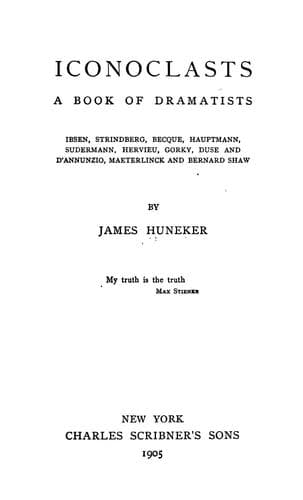
Iconoclasts: A Book of Dramatists: Ibsen, Strindberg, Becque, Hauptmann, Sudermann, Hervieu, Gorky, Duse and D'Annunzio, Maeterlinck and Bernard ShawHuneker, James
History
Iconoclasts: A Book of Dramatists: Ibsen, Strindberg, Becque, Hauptmann, Sudermann, Hervieu, Gorky, Duse and D'Annunzio, Maeterlinck and Bernard Shaw
Huneker, James
Dramatists; European drama -- 19th century -- History and criticism; European drama -- 20th century -- History and criticism
The general impression of the book causes us to believe there is
a rift in the writer's lute; not in his mentality, but in his own
beliefs, or scepticisms. Perhaps Shaw no longer pins his faith to Shaw.
Ibsen asserts that after twenty years a truth that has outlived its
usefulness is no longer _truth_, but the simulacrum of one. Shaw's
truths may be decaying. We feel sure that if they be, he will be the
first to detect the odour and warn away his public. Some years ago
he printed a pamphlet against anarchy and anarchist, which was to be
expected from a mild, frugivorous man. Now he seems to be wearying of
the milk-white flag of socialism; and yet his revolutionary maxims are
maxims for children in the time of teething. The world has moved since
the Fabian society scowled at the British lion and tried to twist its
tail with the dialectics of moderate socialism. To use Mr. Shaw's own
pregnant remark, "Moderation is never applauded for its own sake";
and: "Hewho can, does. He who cannot, teaches." Fabianism taught,
taught moderation! Yet to-day the real thing is not Elisée Reclus,
but Michael Bakounin; not Peter Kropotkin, but Sergei Netschajew; not
Richard Wagner, but his friend, Roeckel, who was sent by him across
the cannon-shattered barricades at Dresden in 1849 to fetch an ice to
the thirsty composer. Wagner rang the alarm bells on this opera bouffe
and escaped to Switzerland, Bakounin and Roeckel remained and went to
prison!
Shaw is still ringing alarm bells, but somehow or other their music is
missing and carries no message to his listeners. Is it possible that he
regrets the anarchy that he has never had the courage to embrace and
avow? A born anarchist, individualist, revolutionist, he has always
gone in for half-hearted measures of reform. Never, like Bakounin,
has he applied the torch, thrown the bomb; never, like Netschajew,
has he dared to pen a catechism of destruction, a manual of nihilism
so terrific that advanced Russian thinkers shudder if you mention its
title. It is even rumoured that the Irish dramatist serves his parish
as a meek citizen should--he will be writing poetry or melodrama next.
His pessimism is temperamental, not philosophical, like that of most
pessimists, as James Sully has pointed out. And instead of closely
observing humanity, after the manner of all great dramatists, he has
only closely studied Bernard Shaw.
"Regarded as a play, Man and Superman is, I repeat, primitive in
invention and second rate in execution. The most disheartening thing
about it is that it contains not one of those scenes of really
tense dramatic quality which redeemed the squalor of Mrs. Warren's
Profession, and made of Candida something very like a masterpiece."
Thus William Archer.
V
Public-domain text, read in full here on John Shaqi.
Reviews
Reviews
No reviews yet
Be the first to share your thoughts on this work.
Elsewhere in the archive
Join the Discussion
Join the discussion
Sign in to leave a comment or review.
Sign InorCreate an account