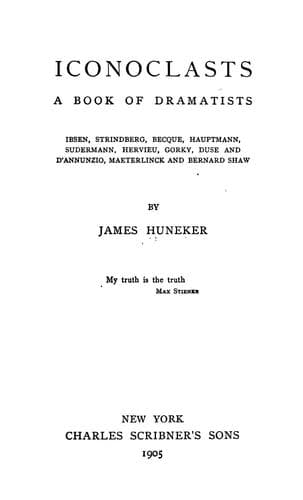
Iconoclasts: A Book of Dramatists: Ibsen, Strindberg, Becque, Hauptmann, Sudermann, Hervieu, Gorky, Duse and D'Annunzio, Maeterlinck and Bernard ShawHuneker, James
History
Iconoclasts: A Book of Dramatists: Ibsen, Strindberg, Becque, Hauptmann, Sudermann, Hervieu, Gorky, Duse and D'Annunzio, Maeterlinck and Bernard Shaw
Huneker, James
Dramatists; European drama -- 19th century -- History and criticism; European drama -- 20th century -- History and criticism
A revolutionary, inasmuch as he deliberately disowns, in his most
characteristic work, all the devices of literature, of rhetoric, of
literary architecture, he is at his worst in prolonged narrative,
such as Foma Gordyeeff. And when he philosophizes he is long-winded.
It is in the short tale with a simple setting that Gorky knows how to
stir us. A strip of sea beach, the sky a hot azure, the water green
as grass, two or three men and women, and we are given a tragedy in
miniature. Or the steppes, sullen and brown, stretch before us to the
setting sun; a few tramps talk at random, night falls. Misery huddles
close. We have felt the very pulse-beat of life--and such lives! A
wretched outcast, starved, wet as a dog in the rain--for he is but a
dog in the rain--meets a woman as miserable and as degraded as himself.
They manage to steal some mouldy bread, and sleep one night in a cask.
It is but the recital of one night. They drift apart in the morning,
never to meet again. Why should they care? Drab and monotonous, their
soiled lives need be viewed but for a moment to surmise their future.
Yet Gorky--for he is his own hero--contrives to sound undertones in
this dark music that appeal. Instinctively he lays bare the souls of
the men and women he dissects--souls as of muddy flame. A dreary sigh
escapes their lips as they drag their poor carcases from place to
place. Life has drugged them with sorrow. Why move at all? Why live at
all? Why were they born? Why do they die? Existence is reduced to a few
primary movements; eat, sleep; if vodka can be secured, then drink it
to oblivion, for the sole blessing in this vale of tears is oblivion.
It may be seen that, compared to Gorky's rank, unsavoury, but sincere
notation of facts, Thomas de Quincey's charming narrative of his
youthful woes in Oxford Street--that "stony-hearted mother"--and
his walks and talks with Anne, the noctambulist, is an idyll. Gorky
transfers to his pages the odours of a starving, sweating humanity,
its drunkenness, its explosions of rage, guttural cries of joy,
and its all too terrible animalism. We turn our heads the other way
when his women curse and rave. Walt Whitman, said Moncure Conway,
brought the slop pail into the drawing-room; but for Gorky there is no
drawing-room. Life is only a dung heap.
For years I have searched for the last word in dramatic naturalism,
and in Gorky's Nachtasyl I found it. I heard it first in Berlin at the
Kleines Theatre, and later in Vienna at the Deutsches Volkstheatre.
Gorky, himself a lycanthrope, pessimist, despiser of his fellow-men,
has assembled in this almost indescribable and unspeakable mélange--for
it is not a play--a set of men and women whose very lives smell to
heaven; the setting recalls one of his stories, Men with Pasts. (It is
in Orloff and his Wife.)
Public-domain text, read in full here on John Shaqi.
Reviews
Reviews
No reviews yet
Be the first to share your thoughts on this work.
Elsewhere in the archive
Join the Discussion
Join the discussion
Sign in to leave a comment or review.
Sign InorCreate an account