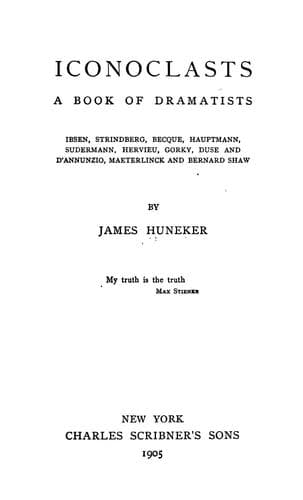
Iconoclasts: A Book of Dramatists: Ibsen, Strindberg, Becque, Hauptmann, Sudermann, Hervieu, Gorky, Duse and D'Annunzio, Maeterlinck and Bernard ShawHuneker, James
History
Iconoclasts: A Book of Dramatists: Ibsen, Strindberg, Becque, Hauptmann, Sudermann, Hervieu, Gorky, Duse and D'Annunzio, Maeterlinck and Bernard Shaw
Huneker, James
Dramatists; European drama -- 19th century -- History and criticism; European drama -- 20th century -- History and criticism
An utter absence of theatricalism and a naïveté in dramatic feeling
proclaim Gorky a man of genius and also one quite ignorant of the
fundamental rules of the theatre. His four acts might be compressed
into two, or, better still, into one. Only the fatigue and gloom
engendered would interfere with this scheme, for there is far too
much talk, far too little movement. Gorky, like many uneducated men
of power, loves to moralize, to discuss life and its meanings. He is
at times veritably sophomoric in this respect. Long speeches are put
into the mouths of his characters, who forthwith spout the most dreary
commonplaces about destiny, luck, birth, and death.
The strength of the play lies in its presentation of character.
Characterization, with a slender thread of narrative, no effective
"curtains," comprises the material of this vivid experiment.
Nevertheless, it burns the memory because of its shocking candour and
pity-breeding truths.
One is struck by a certain resemblance to Charles Dickens in all the
novels of the Russians, Dostoïevsky and Gorky in particular. There are
whole passages in Crime and Chastisement and Injury and Insult that
might have been suggested by the English master of fiction. Gorky,
like Gogol, loves to picture some poor wretch with a dominant passion,
and then to place him in surroundings that will move the machinery of
his being. And with all his hatred of life, of men, pity oozes from
his pages, sometimes contemptuous, sometimes passionate, pity. The
Night Refuge is a cellar with a kitchen, a few holes in the wall for
sleeping purposes. Its counterpart exists in every great city. Thieves,
prostitutes, men and women, the very dregs of life, pass their battered
days and nights in these foul caves. Gorky confesses to having lived
in such places while he wandered through some of the Russian towns.
Anarchists are not, as is popularly supposed, born or bred in these
pest alleys, whose inhabitants are too degraded, too worn out, to
harbour plans for the overthrow of governments. The vermin that burrow
in the mud and darkness are not dangerously brave or endowed with
destructive energies.
Public-domain text, read in full here on John Shaqi.
Reviews
Reviews
No reviews yet
Be the first to share your thoughts on this work.
Elsewhere in the archive
Join the Discussion
Join the discussion
Sign in to leave a comment or review.
Sign InorCreate an account