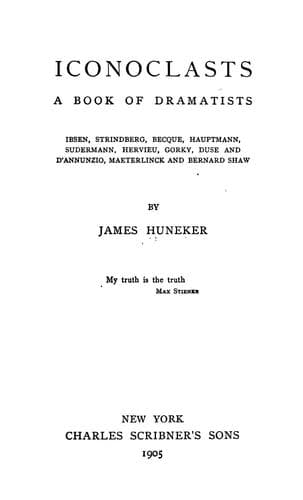
Iconoclasts: A Book of Dramatists: Ibsen, Strindberg, Becque, Hauptmann, Sudermann, Hervieu, Gorky, Duse and D'Annunzio, Maeterlinck and Bernard ShawHuneker, James
History
Iconoclasts: A Book of Dramatists: Ibsen, Strindberg, Becque, Hauptmann, Sudermann, Hervieu, Gorky, Duse and D'Annunzio, Maeterlinck and Bernard Shaw
Huneker, James
Dramatists; European drama -- 19th century -- History and criticism; European drama -- 20th century -- History and criticism
Natascha is that mixture of good, bad, and indifferent in all of us,
and is therefore a puzzle to audiences who like patterns made out of
the whole cloth, without any dubious mixture of light and shade. She
realizes that Wasjka has been her sister's lover; she has been beaten
so that her face and shoulders are often black and blue by her jealous
sister; she knows that her present life is a hell--yet she hesitates;
Luka urges her. Wasjka pleads. Unluckily, the sister returns home
earlier than expected and from a window overlooking the cellar up one
short flight of stairs she overhears the entire conversation. Here is
coincidence childishly introduced to unravel the simplest of dramatic
knots. Yet it seems inevitable. The sister is an envious, prying woman,
always spying upon her boarders. She may have hastened her devotions at
church--like her husband, she is bigoted and hypocritical--and quietly
sneaked in to see what mischief her disreputable crew of lodgers were
making. Pictorially the scene is striking. It recalls any one of the
numerous kitchen pieces of Teniers or Ostade, in which a stout wench is
courted, while from some aperture above a jealous wife threateningly
peers. At the crucial moment in the play the angry creature breaks out
into a volley of abuse. A pretty state of affairs! Such goings-on in
a respectable establishment if her back is turned for a half hour! A
body can't go to church to pray for the sins of her neighbours without
meddle-some old men entering unbidden a decent house and setting every
one by the ears!
After she empties one vial of wrath upon Luka's head she uncorks
another for her unfortunate sister's benefit. A lazy good-for-nothing,
living on the bread of her relatives--a fine marriage she will make
with a thief: a honey-moon in jail, perhaps! The husband puts in
nasty remarks, and Wasjka loses his temper. There is a short, sharp
interchange of blows, but the men are torn asunder. Hush! the police
are always lurking near by, and not even the uncle, himself a member
of the force, a bribe-taker, gambler, and drunkard, could intervene
where blood had been shed. But Wasjka's chance had passed. It does not
return. Natascha, cowed, humbly goes upstairs to the kitchen, there to
clean the samovar, and the aged Luka groans, for he knows what life is,
with its queer eddies and whirlpools of chance.
Public-domain text, read in full here on John Shaqi.
Reviews
Reviews
No reviews yet
Be the first to share your thoughts on this work.
Elsewhere in the archive
Join the Discussion
Join the discussion
Sign in to leave a comment or review.
Sign InorCreate an account