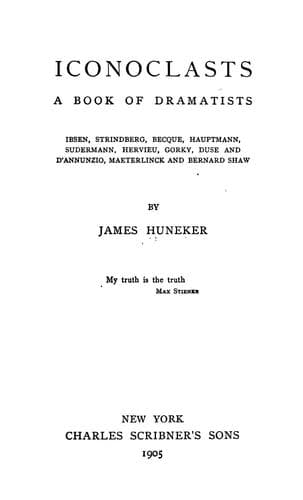
Iconoclasts: A Book of Dramatists: Ibsen, Strindberg, Becque, Hauptmann, Sudermann, Hervieu, Gorky, Duse and D'Annunzio, Maeterlinck and Bernard ShawHuneker, James
History
Iconoclasts: A Book of Dramatists: Ibsen, Strindberg, Becque, Hauptmann, Sudermann, Hervieu, Gorky, Duse and D'Annunzio, Maeterlinck and Bernard Shaw
Huneker, James
Dramatists; European drama -- 19th century -- History and criticism; European drama -- 20th century -- History and criticism
Another case in which Luka interferes is that of the old actor. We
gather from this abject wreck's disconnected speeches that he has been
a dramatic artist in his time; but, as he repeats, parrot-fashion, he
"has poisoned his organism with alcohol." He picked up the phrase from
the doctor at the poorhouse infirmary. This caricature of humanity,
this wraith with a brilliant past, has drifted into the back waters
of the night refuge and there awaits death. One gleam of light he is
made to see before the end. Luka tells him of a city which contains a
hospital for the cure of drunkenness. There must the actor go and there
begin a new life. A new life! The words ravish his ears stunned by
debauchery and wake a momentary vista of hope. Where is this city? Luka
cannot tell. He has forgotten, but he will surely remember. The actor
later relates to the cynical street-walker the good news. His brain
stimulated by the intrusion of a new idea stirs to life. He quotes,
misquotes, Shakespeare; recalls bits of Lear, and breaks down in
recitation. The word, the word--what is it? Exalted he waves his arms
wildly and rushes out to the haven of rest, the tavern. When the dead
woman is surrounded by the speechless crowd, the old actor comes in,
mounts a table, and declaims his speech. He has remembered. The effect
is ghastly.
Luka has conversations with the baron. This odd bundle of bones lives
on the young woman already mentioned. If he can't get vodka, he will
drink drugs; these failing he will sit and gnaw his nails as a mouse
gnaws the wires of its cage, or he will sit cross-legged for hours on
the top of the Russian stove and listen to story-telling. His catchword
is "talk on"; anything for an anecdote. He mocks continually the woman
who supports him. She is an inveterate sentimentalist, and every day
tells a story about a student of noble birth who once threatened to
shoot himself for love of her. But, as the baron sarcastically points
out, the name of this imaginary hero is Gaston one day, another it is
Raoul. He taunts the poor devil into despair and drunkenness. Luka
expostulates. He touches the spring that sets working the young man's
recollections of a happy and honourable past. He was the son of a
wealthy, noble family. He had his coffee in bed in the morning--yes, it
is true! He had servants, horses, a wife. Why was he born? No idea! Why
did he marry? No idea! Why is he still living? No idea! Why will he die?
Public-domain text, read in full here on John Shaqi.
Reviews
Reviews
No reviews yet
Be the first to share your thoughts on this work.
Elsewhere in the archive
Join the Discussion
Join the discussion
Sign in to leave a comment or review.
Sign InorCreate an account