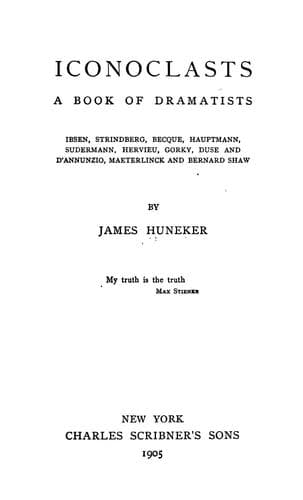
Iconoclasts: A Book of Dramatists: Ibsen, Strindberg, Becque, Hauptmann, Sudermann, Hervieu, Gorky, Duse and D'Annunzio, Maeterlinck and Bernard ShawHuneker, James
History
Iconoclasts: A Book of Dramatists: Ibsen, Strindberg, Becque, Hauptmann, Sudermann, Hervieu, Gorky, Duse and D'Annunzio, Maeterlinck and Bernard Shaw
Huneker, James
Dramatists; European drama -- 19th century -- History and criticism; European drama -- 20th century -- History and criticism
Then the woman has her revenge. It is her chance, and she takes it. She
sneers at the baron's lies. He take his coffee in bed! Not he. Liar
he is when he boasts of his birth. Vagabond! The episode is as ugly
as if it happened under our eyes. His secret weakness exposed, the
baron breaks into hysterical weeping, which presently modulates into
fierce anger. Seizing a glass, he attempts to hurl it at her head. But
the storm subsides, and soon they are all drinking and shouting. You
feel as if you had been viewing the scene from a hidden window, so
realistic is the performance by the troupe of the Kleines Theatre.
The climax is attained in the third act. A row is precipitated during
which the lodging-house keeper is killed. Who struck the blow? Loudly
his widow denounces Wasjka. He is the murderer of her husband, he
the thief who threatened so often the life of her good man. In the
confusion the police rush in, Wasjka is manacled; but so is the
woman, for Natascha bears witness that she overheard her sister
plotting the death of her husband with her lover, Wasjka. The moment
is as theatrically thrilling as you please; hate has the upper hand
in Natascha's heart and her evidence sends the pair to prison. She
disappears.
About this time you begin to suspect that the well-meaning Luka is a
trouble-breeder. Every pie in which he has put his finger so far is
spoiled. He, too, vanishes as noiselessly as he appeared. In Act IV
what is left of the gang sits at the same old dingy table drinking
and discussing, interminably discussing, the events of the past, and
also Luka. He is branded as a liar, a bore, a kill-joy, a busybody,
and one who causes trouble. What if he lies or tells the truth? What's
the difference, anyhow? His truth caused murder, his lies did no one
good, and so they sneer, sneer at the world, sneer at themselves,
occasionally, Pilate-like, asking, what is truth? The Tartar prays
in a corner and reads his Koran, the rest yell out a drunken song,
the shoemaker plays his concertina. The old actor, worse sot than
ever, asks the Tartar to pray for him, goes out to the yard, and
hangs himself. The baron discovers the swinging body and announces
the fact to his comrades. One answers wrathfully, "So he must spoil
our singing--the fool!" And with that the curtain drops, leaving you
puzzled, disgusted, shocked, yet touched. Gorky has caught something
of "the strange, irregular rhythm of life" in this piece, and you feel
the vibration of truth in every line of the extremely plastic dialogue.
That the stage has, or has not, any business with such spectacles never
occurs to the spectator until out upon Berlin's broad avenue of trees
pulsing with life.
Public-domain text, read in full here on John Shaqi.
Reviews
Reviews
No reviews yet
Be the first to share your thoughts on this work.
Elsewhere in the archive
Join the Discussion
Join the discussion
Sign in to leave a comment or review.
Sign InorCreate an account