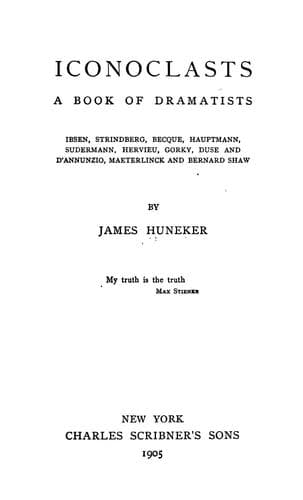
Iconoclasts: A Book of Dramatists: Ibsen, Strindberg, Becque, Hauptmann, Sudermann, Hervieu, Gorky, Duse and D'Annunzio, Maeterlinck and Bernard ShawHuneker, James
History
Iconoclasts: A Book of Dramatists: Ibsen, Strindberg, Becque, Hauptmann, Sudermann, Hervieu, Gorky, Duse and D'Annunzio, Maeterlinck and Bernard Shaw
Huneker, James
Dramatists; European drama -- 19th century -- History and criticism; European drama -- 20th century -- History and criticism
But the contribution of the De Goncourts to the novel will be lasting.
They have one celebrated disciple, Karl Joris Huysmans, who began
under their influence and has traced for himself over the "great
highway so deeply dug out by Zola ... a parallel path in the air by
which we may reach the Beyond and Afterward, to achieve thus, in one
word, a spiritualistic naturalism." In the last analysis Huysmans is
an artistic stepson of the epileptic Dostoïevsky, greatest of all
psychologists; and while he may have forgotten it, his first artistic
springboard was the De Goncourts.
What Henrietta Maréchal accomplished despite its failure, was in the
dialogue--modern, picturesque, and of the best style for the stage,
because it set forth the particular turn of mind of each talker; and
it was also the first attack on that stronghold of French dramatic
tradition, the monotonous semi-chanting of the conservatoire-taught
actor. Here was an elastic, natural dialogue, charged with turns of
phrases taken up from the sidewalk, neologisms, slang--in a word,
lifelike talk as opposed to the old stilted verbiage.
The play was a failure, of course, as we shall see, for extraneous
reasons. The director of the Théâtre Français, M. Edouard Thierry, put
it on, and after the sixth performance, during all of which the actors
never heard their own voices because of the organized popular tumult,
the play was withdrawn. On its publication in book form it sold better
than its author's novels--a fact Zola notes with his accustomed scent
for the perversity of mankind.
Yet, as Daudet declared, Henrietta Maréchal was throughout "a fine,
bold, and novel production. And a short time after, the same people who
had hooted it frantically applauded Heloise Paranquet and the Supplice
d'une Femme, plays of rapid action going straight to their issue, like
a train at full speed, and of which ... Henrietta Maréchal was the
inspiration. And was not the first act, taking place in the opera ball,
with its crowd, its abusive chaff, its masks joking and howling in
pursuit of each other, that close approach to life and reality, ironic
and real as a Gavarni sketch--was it not 'naturalism' on the stage
fifteen years before the word 'naturalism' was invented?"
Daudet, with characteristic delicacy and fidelity to the theme,
elsewhere describes a reading at Edmond de Goncourt's house of his Les
Frères Zemganno--those fraternal heroes of the sawdust.
When the play was read to the members of the Comédie Française,
Minister Rouher--who afterward distinguished himself so terribly in
the Franco-Prussian War!--suggested to the trembling authors that
the valiant girl, who assumes her mother's guilt and is shot dead by
her enraged father, be wounded only, and marry her mother's lover!
Charming, is it not? The suggestion was frowned down by Marshal
Vaillant, an old soldier, who did not fear the smell of stage powder.
Public-domain text, read in full here on John Shaqi.
Reviews
Reviews
No reviews yet
Be the first to share your thoughts on this work.
Elsewhere in the archive
Join the Discussion
Join the discussion
Sign in to leave a comment or review.
Sign InorCreate an account