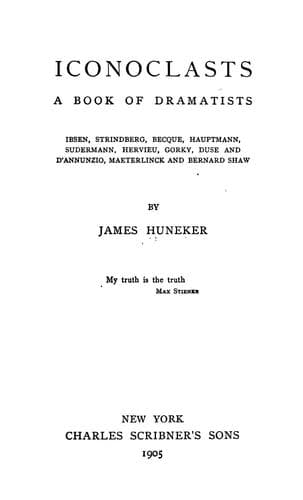
Iconoclasts: A Book of Dramatists: Ibsen, Strindberg, Becque, Hauptmann, Sudermann, Hervieu, Gorky, Duse and D'Annunzio, Maeterlinck and Bernard ShawHuneker, James
History
Iconoclasts: A Book of Dramatists: Ibsen, Strindberg, Becque, Hauptmann, Sudermann, Hervieu, Gorky, Duse and D'Annunzio, Maeterlinck and Bernard Shaw
Huneker, James
Dramatists; European drama -- 19th century -- History and criticism; European drama -- 20th century -- History and criticism
Written in 1863, Henrietta Maréchal was not produced until December 5,
1865, at the Comédie Française, and after its speedy withdrawal it was
not revived until March 3, 1885, at the Odéon. In the preface to the
De Goncourts' Théâtre, Edmond wrote of the painful struggles the pair
endured to obtain a hearing. They composed a vaudeville, Sans Titre,
which was not heard, and followed this by other attempts, during which
they slowly attained some knowledge of dramatic construction, and in
1867 followed Henrietta Maréchal with a five-act prose drama called
La Patrie en Danger. This was also read at the Française, in 1868,
admired, and dropped. Edmond declared it superior to its predecessor.
It deals with the epoch of the French Revolution, and need not concern
us now.
Of interest is his declaration that in the novel he is a realist (he
is really a modified romantic, with a romantic vocabulary, selecting
for subjects modern themes); but in the drama he totally disagrees
with Zola and his naturalistic formulas as applied to the theatre.
They have dug up a letter he sent over a decade ago to M. Lothar, who
made the German translation of La Faustin. It all is to be found in
this preface of 1879. De Goncourt, who naturally ranks the drama below
the novel as literature, upholds the conventions of the former. The
drama is by its nature romantic and limited in scope. The monologues,
asides, dénouements, sympathetic characters, and the rest must always
endure. He does think, however, that reality may be brought nearer, and
that literary language should give place to a style which will reveal
the irregularity and abruptness of vital conversation. In this latter
particular he has been a benefactor. Unnatural theatrical dialogue he
slew with his supple, free, naturally coloured speech in Henrietta
Maréchal. Stage talk should be, De Goncourt asserted, flowing and
idiomatic--never bookish. The ball scene in Henrietta proves that the
brothers could practise as well as preach.
Public-domain text, read in full here on John Shaqi.
Reviews
Reviews
No reviews yet
Be the first to share your thoughts on this work.
Elsewhere in the archive
Join the Discussion
Join the discussion
Sign in to leave a comment or review.
Sign InorCreate an account