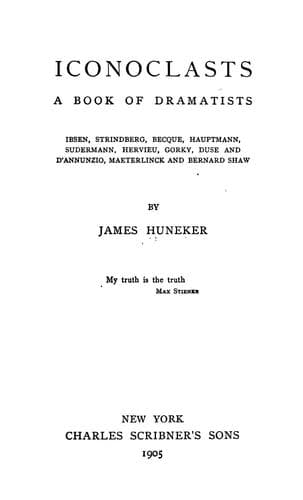
Iconoclasts: A Book of Dramatists: Ibsen, Strindberg, Becque, Hauptmann, Sudermann, Hervieu, Gorky, Duse and D'Annunzio, Maeterlinck and Bernard ShawHuneker, James
History
Iconoclasts: A Book of Dramatists: Ibsen, Strindberg, Becque, Hauptmann, Sudermann, Hervieu, Gorky, Duse and D'Annunzio, Maeterlinck and Bernard Shaw
Huneker, James
Dramatists; European drama -- 19th century -- History and criticism; European drama -- 20th century -- History and criticism
Duse possesses the subtle hands of that painter's Lisa Gioconda, and
as the motive of D'Annunzio's play springs from a pair of hands--its
original title was The Tragedy of the Beautiful Hands--Signora Duse
makes of her fingers ten eloquent signals.
The opportunity for theatric climax is rare in La Gioconda; but
when it does come the effect is strong. A wife, whose love and
devotion are slighted, dares to face her rival in the studio of the
sculptor-husband. He has endeavoured desperately to wean himself from
his passion for the model who posed as his masterpiece, a Sphinx.
Attempted suicide before the action of the play proved how deeply sunk
in his imagination is this crazy infatuation. His wife meets the woman,
who is young, beautiful, strange, and absolutely enamoured of the
sculptor. Of her sincerity there is no doubt. Then the dramatist throws
wire-drawn analysis to the winds and in a scene of peculiar brutality
the women duel for the possession of the gifted, worthless man.
Here Duse's imagination and technic are revealed. She must remain the
refined woman, though her brain is afire, her soul up in arms. In acrid
terms of reproach and irony she defies the temptress of her husband,
knowing full well that he is lost to her; in the very flush of defeat
she would pluck victory by the sleeve. Startled by the ready assurance,
enraged by the seemingly triumphant wife, Gioconda, the model, rushes
into the atelier, bent upon destroying her counterfeit in clay,--that
figure she so lovingly guarded during the sculptor's illness.
She had watched the work of his soul, while his wife nursed only his
sick body. With this she taunts the other. In despair before the
looming catastrophe, Duse, the wife, cries that she has lied, that her
husband still loves his model. But it is too late. The struggle of the
women is heard. A crash and a scream announce that the statue has been
overthrown. Then an ugly Sardou motive is obtruded.
With the shadow of eternal regret in her eyes, her hands wrapped in the
wet cloths that bound the clay, Duse staggers from behind the draperies
of the atelier. She has saved her husband's statue, but her beautiful
hands are hopelessly maimed. This scene is hideously cruel. And to top
the _crescendo_ of woe, the vacillating man runs in. "You, you, you!"
sobs his wife; "it is saved," and the curtain blots the agonizing
situation from our eye, not from our memory.
Public-domain text, read in full here on John Shaqi.
Reviews
Reviews
No reviews yet
Be the first to share your thoughts on this work.
Elsewhere in the archive
Join the Discussion
Join the discussion
Sign in to leave a comment or review.
Sign InorCreate an account