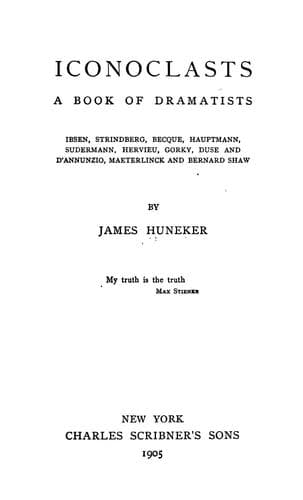
Iconoclasts: A Book of Dramatists: Ibsen, Strindberg, Becque, Hauptmann, Sudermann, Hervieu, Gorky, Duse and D'Annunzio, Maeterlinck and Bernard ShawHuneker, James
History
Iconoclasts: A Book of Dramatists: Ibsen, Strindberg, Becque, Hauptmann, Sudermann, Hervieu, Gorky, Duse and D'Annunzio, Maeterlinck and Bernard Shaw
Huneker, James
Dramatists; European drama -- 19th century -- History and criticism; European drama -- 20th century -- History and criticism
sense is exquisite; yet too much literature often kills the humanity of
his characters. And he is always more lyric than dramatic.
"Gabriele d'Annunzio," writes M. Huret, "is of medium height, slender,
not to say frail, with short, reddish hair which is growing thin on the
top of his finely shaped head, and this he brushes straight back at the
temples; his back already somewhat bent, he has the air of one of those
aristocratic beings who have begun life too soon. His ruddy mustache
is trimmed close to the lip, and the points are turned up sharply at
the corners, while the chin ends in a little pointed beard. The nose is
regular and shows strength; the division between the nostrils extends
below in a prominent lobe. His eyes, of pale blue, like a faded violet,
are half veiled by his heavy lids. Beneath these eyes the network of
fine lines tells the story of precocious weariness. The finely shaped
mouth opens widely in a smile over carefully tended teeth. And one
may search in vain in that face for any trace of the overwhelming,
almost savage, sensuality which his privileged hero manifests in all
his novels. The appearance of his physiognomy as a whole is rather
self-contained and cold. He is a thinker, assuredly quite master of
himself, much more given to enthusiasm over a beautiful verse than
capable of a real emotion over another's grief. Besides, has he not
written, 'One must keep one's liberty complete at any cost, even in
intoxication'?"
D'Annunzio has ever been a spoiled darling of the Muses. At the age
of sixteen, after he had published that turbulently erotic book of
verse, Primo Vere, Marc Monnier, the critic, wrote of him in the _Revue
Suisse_, "If I were one of his masters I should give him a medal and
the stick."
It is to be hoped that with increasing age and experience he will
pierce beneath the vesture of things and seek for the message
spiritual. He is now the poet of the fleshly, albeit an interpreter of
its beauties. The poet in him celebrates the joy of living, the joys
of love, of death,--oh, he can pipe you many sweet lays of Death the
Triumpher!--of wine, of art. He has just begun to write for the stage,
and is unduly preoccupied with the sumptuousness of externals, with the
bravery of words, with the torturing complexities of character.
II
Gabriele d'Annunzio's La Gioconda is a four-act tragedy of power,
beauty, and horror. Despite the reputation of the poet-dramatist
and his undeniable qualities of copious invention, skilful
characterization, and prime literary ability, this piece was not warmly
received in Italy. Its unrelieved analysis, its slowly accumulating
burden of misery, and the cruelty of the climax do not allure the
average listener. And the poet in D'Annunzio shows at every line--there
are many gorgeous ones spoken in La Gioconda.
Public-domain text, read in full here on John Shaqi.
Reviews
Reviews
No reviews yet
Be the first to share your thoughts on this work.
Elsewhere in the archive
Join the Discussion
Join the discussion
Sign in to leave a comment or review.
Sign InorCreate an account