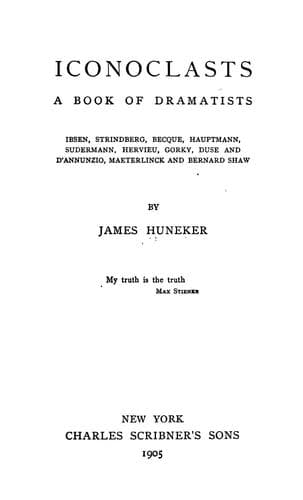
Iconoclasts: A Book of Dramatists: Ibsen, Strindberg, Becque, Hauptmann, Sudermann, Hervieu, Gorky, Duse and D'Annunzio, Maeterlinck and Bernard ShawHuneker, James
History
Iconoclasts: A Book of Dramatists: Ibsen, Strindberg, Becque, Hauptmann, Sudermann, Hervieu, Gorky, Duse and D'Annunzio, Maeterlinck and Bernard Shaw
Huneker, James
Dramatists; European drama -- 19th century -- History and criticism; European drama -- 20th century -- History and criticism
After the third act any dramatist would have cried quits. Not so
D'Annunzio. He wishes to tell us that Silvia is deserted forever.
Pathos, poetic in its quality, contrasts with the horror of the
preceding scene. We are shown Silvia at the seaside, her crushed hands
concealed. To her comes La Sirenetta, an elfin creature of the sea,
a tiny, fantastic fisher maid, who sings the delightful ballad of
the Seven Sisters and consoles the sorrowful wife and mother. Yes,
Silvia has a daughter, Beata, who is kept in ignorance of her mother's
misfortune.
It is now that the spectator feels the remorseless grip of the poet.
La Sirenetta offers a star-fish to Silvia and wonders why she does not
accept it. She is the solitary shaft of sunshine in the play. Beata
runs in with flowers for her mother. It is a poignant touch. The chilly
indifference of the dramatist to the suffering of his characters, his
complete detachment, is art of a rarefied sort, though not the art
that will endear him to all. "Beata!" exclaims the poor mother, making
a futile gesture with her mutilated arms. "You are crying! You are
crying!" sobs the child, throwing herself upon her mother's breast. The
flowers slip to earth.
A trait of Duse is the stifling of her tears when her sister
visits her. She involuntarily lifts her arms, and then, checking
herself with an indescribable movement, she rests her face upon her
sister's shoulder. There the tears fall. There she dries them. It is
characteristic Duse. Her entire assumption is on the plane of exalted
realism. We know that Silvia has a beautiful, strong soul, that she
succumbs to the awful pressure of temptation; and the lie she tells
is henceforth a memory never lifted from her life. In a measure she
accepts with resignation physical torture and loss of her husband.
D'Annunzio has not before created such a noble woman. Lucio is only
a variant of his typical man: George Aurispa, Andrea Sperelli, and
the rest of his amateurs in corruption and artistic hunters of morbid
sensation. Silvia is unique. Silvia is adorable as Duse presents her.
Throughout this most human among actresses is in constant modulation;
her very silence is pregnant with suggestion. She is the exponent of an
art that is baffling in its coincidence with nature. From nature what
secret accents has this Italian woman not overheard?--secrets that she
embodies in her art.
Public-domain text, read in full here on John Shaqi.
Reviews
Reviews
No reviews yet
Be the first to share your thoughts on this work.
Elsewhere in the archive
Join the Discussion
Join the discussion
Sign in to leave a comment or review.
Sign InorCreate an account