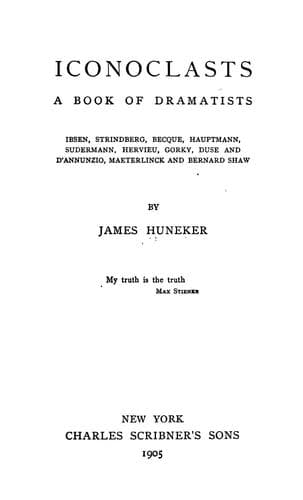
Iconoclasts: A Book of Dramatists: Ibsen, Strindberg, Becque, Hauptmann, Sudermann, Hervieu, Gorky, Duse and D'Annunzio, Maeterlinck and Bernard ShawHuneker, James
History
Iconoclasts: A Book of Dramatists: Ibsen, Strindberg, Becque, Hauptmann, Sudermann, Hervieu, Gorky, Duse and D'Annunzio, Maeterlinck and Bernard Shaw
Huneker, James
Dramatists; European drama -- 19th century -- History and criticism; European drama -- 20th century -- History and criticism
There are many beauties in the play, beauties of style, though the
dialogue in the early acts is in excess of the movement This is quite
in consonance with continental ideas of playwriting. In Europe the
art of elocution is not a lost one, as it is on the English stage.
The Italians and the French often speak for the sheer beauty of their
expressive tongues. So the action halts and there are some amateurish
strokes betrayed in the bringing on of his characters by D'Annunzio.
But the burning rhetoric of the young poet lends fascination to several
scenes--notably the interview of painter and sculptor in Act II. His
brother-poet, Arthur Symons, has Englished D'Annunzio's prose and has
accomplished his task with rare distinction.
III
D'Annunzio's Francesca da Rimini is glorified melodrama. It is
unnecessary to revert to the plays, poems, books, pictures, symphonies,
that have been made with the unhappy loves of Francesca and Paolo as
a theme. From the day when the great Florentine exile sang in Canto V
of his Hell, "In its leaves that day we read no more," Dante inspired
painters, poets, sculptors,--Rodin not among the least,--musicians,
and playwrights. Leigh Hunt wrote The Story of Rimini; there is George
Boker's commonplace play, in which Lawrence Barrett, Louis James, Otis
Skinner, and others have appeared; there is an old play by Silvio
Pellico, and the two new settings of the story by Stephen Phillips and
Marion Crawford--the latter's version prepared for Sarah Bernhardt--are
of yesterday's doings. Both Liszt and Tschaïkowsky have composed
symphonic poems on the subject.
Public-domain text, read in full here on John Shaqi.
Reviews
Reviews
No reviews yet
Be the first to share your thoughts on this work.
Elsewhere in the archive
Join the Discussion
Join the discussion
Sign in to leave a comment or review.
Sign InorCreate an account