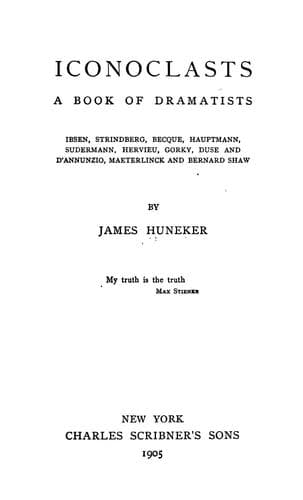
Iconoclasts: A Book of Dramatists: Ibsen, Strindberg, Becque, Hauptmann, Sudermann, Hervieu, Gorky, Duse and D'Annunzio, Maeterlinck and Bernard ShawHuneker, James
History
Iconoclasts: A Book of Dramatists: Ibsen, Strindberg, Becque, Hauptmann, Sudermann, Hervieu, Gorky, Duse and D'Annunzio, Maeterlinck and Bernard Shaw
Huneker, James
Dramatists; European drama -- 19th century -- History and criticism; European drama -- 20th century -- History and criticism
It is the externals of the drama with which we are more concerned. Of
five acts three were placed in the _loggia_ of Leonardo's house; Act II
is the interior of the same house; Act V a fountain not far away. It
is then a soul tragedy that is enacted, and one cannot quite escape
the feeling that much study of Maeterlinck has been responsible for
the sullen, depressing atmosphere. There is in the dialogue, with its
haunting repetitions, the same electric apprehension sensed in the
Belgian's poems. Gestures, movements, the music of sonorous speech,
slow glances, and pauses--the pause is a big factor in Maeterlinck--are
woven into a sort of incomprehensible symphony.
Seemingly subordinate, Eleonora Duse is the real protagonist. Blind,
though not from birth, because of her exquisite tactile sensibility
she understands the love of her husband for her friend. An exalted
sentiment of renunciation prompts her to probe this secret passion,
and when she discovers that Bianca is languishing, too, her mind is
made up. She will efface herself. She will slay her useless life, So
that two souls may thrive in happiness. More than this, she tempts her
husband with the ripe beauty of Bianca. Here is an un-Greek idea at
once. It is altruism gone mad. From Anna is mercifully kept the unholy
love of the brother; nor is it revealed to Bianca. Therein lies another
deviation from antique models. A story in classical literature is never
told obliquely.
Duse, who has extraordinary powers of intuition, the logic of her
temperament, impersonated Anna with unvarying truth and veiled
sweetness, indicating by shades almost too fine for the frame of the
theatre her mental attitudes toward her companions. There are few
climaxes for her, the part being a passive one, the action being buried
in the text. But she has opportunities. Her cry for "Light!" is one;
and almost at the drop of the last curtain she finds her way to the
fountain where, lured by the brother Alessandro, Bianca, his hapless
victim, is murdered by being drowned in the murmuring waters which the
pair have so often watched.
Anna utters the names in the terrified accents of the lost blind. She
seeks, too, her husband. All the day she anticipated tragedy. It hung
over her soul like a smoky pall. She feels her way to the fountain and
there touching with her feet the body of the dead girl she distractedly
searches for signs of life. It is a dramatic moment. Then arising with
a shudder she shouts, joyfully:--
Public-domain text, read in full here on John Shaqi.
Reviews
Reviews
No reviews yet
Be the first to share your thoughts on this work.
Elsewhere in the archive
Join the Discussion
Join the discussion
Sign in to leave a comment or review.
Sign InorCreate an account