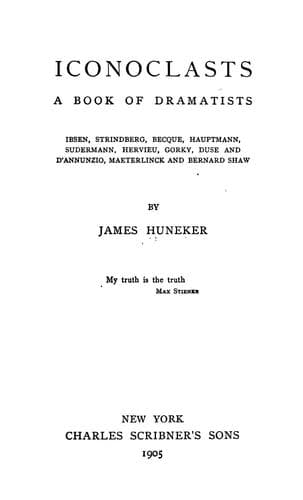
Iconoclasts: A Book of Dramatists: Ibsen, Strindberg, Becque, Hauptmann, Sudermann, Hervieu, Gorky, Duse and D'Annunzio, Maeterlinck and Bernard ShawHuneker, James
History
Iconoclasts: A Book of Dramatists: Ibsen, Strindberg, Becque, Hauptmann, Sudermann, Hervieu, Gorky, Duse and D'Annunzio, Maeterlinck and Bernard Shaw
Huneker, James
Dramatists; European drama -- 19th century -- History and criticism; European drama -- 20th century -- History and criticism
It is then a crime contemplated, not accomplished, this love of a
brother for a sister. A critic might show that the Italian poet's form
is a replica of the Greek with several variations; there is a breach of
unity of place in the last act, and no "false catastrophe" is hinted
at in the fourth act. This W. F. Apthorp has pointed out. It is not
the sole departure. Instead of presenting us with a frozen imitation
of Grecian tragedy, like most writers who have attempted to cope with
the classics, D'Annunzio frankly filled the antique mould with modern
feeling.
His men and women are modern; they are of to-day, neurotic, morbid,
febrile souls. And this modern atmosphere is a jangling dissonance to
them that prefer their tragedy unadulterated. Without an ounce of John
Ford's lusty Elizabethan animalism, D'Annunzio so contrives his play of
character and shock of incident that we are disquieted, dismayed, not
so much by the theme as by its insidious music.
With his customary audacity he places his action in Greece, on the
plain of Argolis; archæology is the background. Four friends are
engaged in excavating the dead city of Mycenæ, where Schliemann
discovered, or thought he discovered, the tombs and dusty bones of the
Homeric heroes. From these tainted remains is exhaled the moral malaria
that sets in action D'Annunzio's piece. It is a genuinely original and
morbid idea.
The house of the men of Atreus is dug up, and from it comes spiritual
pollution. Like a master of string-quartet writing the author has
manipulated his four characters so skilfully that the melody worked is
ever mysterious, ever melancholy. Anna is blind; she is the wife of
Alessandro, a poet and scholar. Alessandro is morally blind, for he
loves the younger Bianca, the sister of his friend Leonardo. Leonardo,
the successful explorer and rifler of Homeric tombs, loves his own
sister,--that ancient poison working in his veins,--and with this
uncanny combination D'Annunzio plays his sinister tunes, evokes his
strange harmonies.
There is no necessity of disputing the daring of this scheme, and
just as inutile would be a discussion of its ethics. It seems that
in his three plays, La Gioconda, La Citta Morta, and Francesca da
Rimini, D'Annunzio has tried his 'prentice hand at modern realism,
ancient tragedy, and historical melodrama. They are all three largely
experimental, and, it must not be forgotten, the works of a beginner.
Public-domain text, read in full here on John Shaqi.
Reviews
Reviews
No reviews yet
Be the first to share your thoughts on this work.
Elsewhere in the archive
Join the Discussion
Join the discussion
Sign in to leave a comment or review.
Sign InorCreate an account