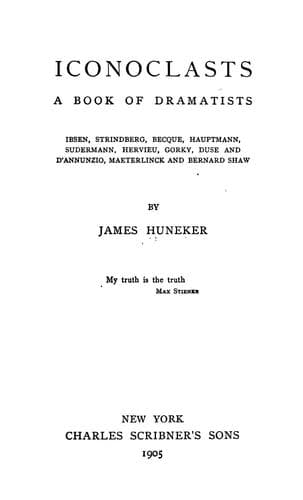
Iconoclasts: A Book of Dramatists: Ibsen, Strindberg, Becque, Hauptmann, Sudermann, Hervieu, Gorky, Duse and D'Annunzio, Maeterlinck and Bernard ShawHuneker, James
History
Iconoclasts: A Book of Dramatists: Ibsen, Strindberg, Becque, Hauptmann, Sudermann, Hervieu, Gorky, Duse and D'Annunzio, Maeterlinck and Bernard Shaw
Huneker, James
Dramatists; European drama -- 19th century -- History and criticism; European drama -- 20th century -- History and criticism
The first act is the best, because the simplest and most sincere.
It shows us a living room in a rustic house. The background and
"properties" are said to be wonderfully realistic. Aligi, the shepherd,
is to marry. His bride's name is Vienda. He does not love her, for she
was chosen by his parents--and in this old Italian land the father's
command is law. The betrothal ceremonies are beginning. The groom's
sisters are near by. He is ill at ease, for he has been dreaming
strange dreams. Vienda spills the broken bread of betrothal from her
lap upon the floor. It is a maleficent sign. Suddenly there comes a
noise of shouting and music. The harvesters, crazy with drink and
the torrid heat of the sun, rush in. They have come to celebrate.
They are also chasing a human being, a miserable hunted girl of bad
repute, the daughter of Jorio, the magician. Hunted down, she claims
sanctuary in the household. Although she is of ill-fame, although
Aligi's father, Lazaro, has been wounded in a squabble about this girl,
Mila di Codra, she is sheltered by the woman. Aligi is for turning
her away; her coming spells more bad luck; the infuriated mob without
demand admittance. Enraged, the shepherd raises his staff to strike the
unhappy fugitive. As he does this he is overtaken by fresh visions;
he thinks he sees Mila guarded by a weeping angel. He falls at her
feet begging her pardon. A cross is laid over the threshold, a litany
sung by his sisters, and the angry reapers are hypnotized. They enter
singly, kiss the cross, and dissolve homeward. Lazaro enters with his
head in a bandage and Mila escapes. Another ill omen--the father and
son both love the same woman.
Public-domain text, read in full here on John Shaqi.
Reviews
Reviews
No reviews yet
Be the first to share your thoughts on this work.
Elsewhere in the archive
Join the Discussion
Join the discussion
Sign in to leave a comment or review.
Sign InorCreate an account