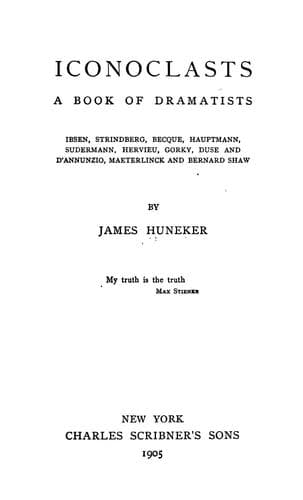
Iconoclasts: A Book of Dramatists: Ibsen, Strindberg, Becque, Hauptmann, Sudermann, Hervieu, Gorky, Duse and D'Annunzio, Maeterlinck and Bernard ShawHuneker, James
History
Iconoclasts: A Book of Dramatists: Ibsen, Strindberg, Becque, Hauptmann, Sudermann, Hervieu, Gorky, Duse and D'Annunzio, Maeterlinck and Bernard Shaw
Huneker, James
Dramatists; European drama -- 19th century -- History and criticism; European drama -- 20th century -- History and criticism
The second act discovers Aligi and Mila in a mountainous cave where
they have lived for six months--in a state of innocence. Here the
credulity of the spectator is taxed, and the lyric ecstasy of the poet
waxes. It is nevertheless an idyllic episode. One kiss is exchanged,
the first and the last, for Lazaro eventually finds his now disgraced
son, and with a pair of sturdy rustics comes to carry away the witch.
In the conflict that ensues the son murders the father. Act III brings
us back to the old home of Aligi. His father's corpse lies in the
garden, according to custom. The son is condemned to the awful death
of the parricide--after his offending hand is cut off he is to be tied
in a sack with a fierce dog and then thrown into the river. The end
may be surmised. One consolation is not denied him--a cup of drink to
induce forgetfulness. As the preparations are about completed Mila
bursts upon the crowded scene--an impressive one, according to printed
reports--and takes upon herself the blame of the affair. She it was,
she declares, who murdered Lazaro. Aligi curses her in his delirium,
as she is dragged away to be burnt alive, she the witch, the daughter
of Jorio. Her triumphant voice is heard to the last, while for a
background there is the chanting of the requiem and the triumphant
yelling and imprecations of the shepherds, the Abruzzi lusting for a
human sacrifice. Then the curtain falls. Several critics discern in
all this the triumph of religion over the senses--a solution that does
their ingenuity credit, though far from convincing.
It may be seen that there is real dramatic worth in the play, love
and sacrifice being its very pith. Better still, the poet has become
less self-absorbed and consequently more objective. The human note
predominates in this wild and highly coloured music. In his plays and
novels and verse he has himself been the artistic and sterile hero--as
Eleonora Duse, in the plays and one novel, their heroine. A German
critic declares that Mila is only a sister of the crazy woman in A
Spring Morning's Dream--as she, Duse, also is related to Silvia in
Gioconda, to the blind wife in The Dead City, and Francesca, as well as
La Foscarina in Fuoco, Duse, Eleonora Duse, always Duse. Lucky, thrice
happy poet, to have been inspired by such a model! To have had the
opportunity of studying such a sublime, unhappy soul as is Duse's!
A German critic speaks slightingly of Das Geklingel der schönen
Phrasen--the jingling of dulcet phrases--as a drawback to the action.
Doubtless this is true. Often we cannot hear the play because of the
words. The chief thing to be remarked, however, is the improvement
in dramatic spirit and rhythm and the gratifying supremacy of the
dramatic over the lyric and literary qualities--the latter hitherto
anti-dramatic elements in the plays of D'Annunzio.
Public-domain text, read in full here on John Shaqi.
Reviews
Reviews
No reviews yet
Be the first to share your thoughts on this work.
Elsewhere in the archive
Join the Discussion
Join the discussion
Sign in to leave a comment or review.
Sign InorCreate an account