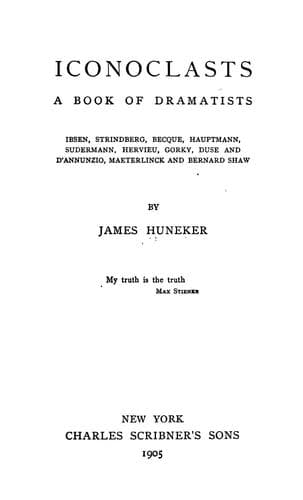
Iconoclasts: A Book of Dramatists: Ibsen, Strindberg, Becque, Hauptmann, Sudermann, Hervieu, Gorky, Duse and D'Annunzio, Maeterlinck and Bernard ShawHuneker, James
History
Iconoclasts: A Book of Dramatists: Ibsen, Strindberg, Becque, Hauptmann, Sudermann, Hervieu, Gorky, Duse and D'Annunzio, Maeterlinck and Bernard Shaw
Huneker, James
Dramatists; European drama -- 19th century -- History and criticism; European drama -- 20th century -- History and criticism
Not precisely dissolute, rather disorganized, the life of Adam
could be transformed into an object sermon by the wily educator and
moral-monger. But that would be a poor way of viewing it. Born without
average will power, except the will to imagine beautiful and strange
things, Villiers, as he is generally called, all his years fought the
contending impulses of his dual nature; fought bravely sometimes in
the open air with the blue sky smiling down on him; fought as if facing
an ambuscade at dark, and under the lowering clouds when all the powers
of evil were abroad and at his elbow. Then, he was what Bayard Taylor
called Edgar Poe--a bird of the night; a prowling noctambulist; a
feverish being, whose violent gestures, burning eyes, and irresolute
somnambulistic gait told the tale, the damnable and thrice-told tale,
of wasted genius.
Poe is the literary ancestor of nearly all the Parnassian and Diabolic
groups--ah, this mania for schools and groups and movements in
Paris! Poe begat Baudelaire and Baudelaire begat Barbey d'Aurevilly
and Villiers de l'Isle Adam, and the last-named begat Verlaine and
Huysmans--and a long chain of other gifted men can claim these two as
parents, even to Mallarmé, De Maupassant, and Henri de Régnier (who has
read the Horla of Guy de Maupassant will feel that therein the unhappy
disciple of Flaubert has raised to a terrifying degree the methods
of Poe; nor must Régnier's La Canne de Jaspe be forgotten). But they
all come from Poe; Poe, who influenced Swinburne through Baudelaire;
Poe, who nearly swept the young Maeterlinck from his moorings in the
stagnant fens and under the morose sky of his lowlands. If we have no
great school of literature in America, we can at least point to Poe as
the progenitor of a half-dozen continental literatures.
Villiers can be traced to Poe on one side, just as Chateaubriand is
another of his ancestors. M. de Gourmont deplores the criticism which
would detach Villiers from his time and isolate him as a species of
intellectual monster. There is much that is fantastic, even bizarre,
in his work, and he never escaped the besetting sin of his associates,
headed by Baudelaire, the childish desire to _épater le bourgeois_,
to shock conventional morality and manners by eccentric behaviour,
outrageous speech, and paradoxical writings. This legacy of the
romantic movement of 1830 really came across the water in Byron's
poses of wickedness and heroic mystifications. It was, in reality, the
Byronic attitude transposed to the Paris boulevards. Gautier wore a
pink doublet (not scarlet, he says), and it was elevated to a symbol.
Let us be scarlet, said these wild, young fellows, let our sins be
splendid! And then the crew would wander abroad, making the night
resound with their lyric outbursts, happy if a respectable citizen were
scandalized, and in their pockets, a world too wide for their money,
hardly the price of a bottle!
Public-domain text, read in full here on John Shaqi.
Reviews
Reviews
No reviews yet
Be the first to share your thoughts on this work.
Elsewhere in the archive
Join the Discussion
Join the discussion
Sign in to leave a comment or review.
Sign InorCreate an account