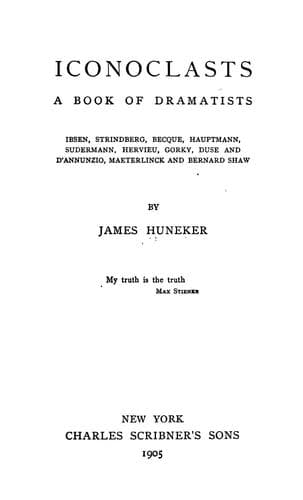
Iconoclasts: A Book of Dramatists: Ibsen, Strindberg, Becque, Hauptmann, Sudermann, Hervieu, Gorky, Duse and D'Annunzio, Maeterlinck and Bernard ShawHuneker, James
History
Iconoclasts: A Book of Dramatists: Ibsen, Strindberg, Becque, Hauptmann, Sudermann, Hervieu, Gorky, Duse and D'Annunzio, Maeterlinck and Bernard Shaw
Huneker, James
Dramatists; European drama -- 19th century -- History and criticism; European drama -- 20th century -- History and criticism
It was glorious, and it was art. But who cared, who knew? If a man of
Baudelaire's intellectual powers, a profound critic, genius, and poet,
could dye his hair green, simply to attract attention in the cafés
why should not men of lesser abilities follow suit and commit all
manner of extravagant pranks? Leconte de Lisle, impeccable poet and
a prim sort of person, impatiently exclaimed: "Oh, ces jeunes gens!
Tous fumistes!" And Thiers allowed to escape him the one _mot_ of his
complacent life worth remembering, "The Romanticists--that's the
Commune!" Perhaps the pink doublets and strange oaths of Ernani and
1830 were transformed into the grim figures of that later lurid epoch.
Villiers was in the very core of this artistic Paris. He slept all
day--or dreamed. At nightfall he stepped across the sill of his door,
and when he had friends, money, glory, he dined at Brébant's; when
he was shabby, he remained on the exterior boulevard. There, in some
modest café, seated at a table surrounded by disciples eager for his
ideas, his poetry, his scintillating wit,--eager to steal it and sell
it as their own,--the Master spoke, his vague blue eyes gleaming, his
long white hand waving aloft like a flag of revolt. What dreams, what
eloquence, what a soul, went under on this ignoble battle-field! What
slain ideals and poetry wasted in the very utterance, and what inroads
on a nervous, sickly constitution! But Villiers lived the life he had
elected. He was poor, always poor, and poverty makes extraordinary
bedfellows. But--his room-mates were the most intellectual spirits of
modern France. If Baudelaire could not drop in on him at his dusty
lodgings, Richard Wagner would. And so there was talk--such talk--and
there was that feeling of expansion, of liberation, which comes when a
man like Turgenev could say to Flaubert: "Cheer up, old fellow! After
all you are _Flaubert!_"
Villiers never forgot that he was Villiers. His pride, like his piety,
was Luciferian. Nobly descended, he almost fought a duel with a distant
cousin who doubted his birth. He claimed to spring from the ten times
blue blood of a Grand Master of the Order of Saint John of Jerusalem,
who defended Rhodes against the Turks in the time of Charles V. With
this thought he often wandered into a café and had his absinthe charged
on the slate of the ideal, the reckoning of which no true poet listeth.
Public-domain text, read in full here on John Shaqi.
Reviews
Reviews
No reviews yet
Be the first to share your thoughts on this work.
Elsewhere in the archive
Join the Discussion
Join the discussion
Sign in to leave a comment or review.
Sign InorCreate an account