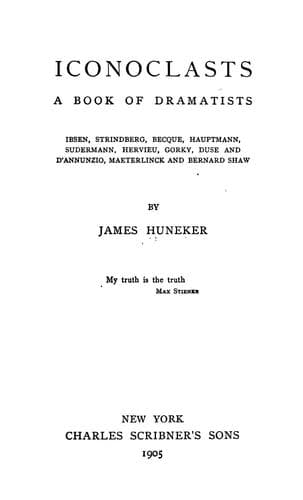
Iconoclasts: A Book of Dramatists: Ibsen, Strindberg, Becque, Hauptmann, Sudermann, Hervieu, Gorky, Duse and D'Annunzio, Maeterlinck and Bernard ShawHuneker, James
History
Iconoclasts: A Book of Dramatists: Ibsen, Strindberg, Becque, Hauptmann, Sudermann, Hervieu, Gorky, Duse and D'Annunzio, Maeterlinck and Bernard Shaw
Huneker, James
Dramatists; European drama -- 19th century -- History and criticism; European drama -- 20th century -- History and criticism
"Take care," says the old man; "we do not know how far the soul extends
about men...." The dénouement is touching.
From Holbein to Saint-Saëns art shows a procession of dancing
Deaths--always dancing with bare bones that creak triumphantly.
In Maeterlinck's mimings there is something of the spirit of Walt
Whitman's threnody.
The Belgian translates the idea of Death into phrases more hypnotic
than Whitman's. His "cool-enfolding Death" is not always "lovely
and soothing" for the survivors. His cast of mind is mediæval, and
presently comes sailing into the critical consciousness memories of the
Pre-Raphaelitic Brotherhood with its strained attitudes, its glories
of illuminated glass, its breathless intensity and concentration upon
a single theme--above all its apotheosis of the symbol and of Death
the Intruder. It is one more link in the development of our young
dramatist. He knew Poe and Emerson; he appreciated Rossetti both as
poet and painter. In the next group of plays under consideration a step
nearer life may be noted, a stronger element of romance betrays itself.
We are approaching, though deliberately, Maeterlinck, the Romantic.
III
Israel Zangwill told a story once about Maeterlinck that is curious
even if not true. He said the Belgian poet, when a young fellow, was
on one of his nocturnal prowls, and while sitting in a café overheard
a man explain a new dramatic technic to his friend. In it was the germ
of the Maeterlinck plays. Possibly the plays for marionettes, Les
Flaireurs, of Charles van Lerberghe were a starting-point. The growth
of the poet on the technical side, as well as the evolution from vague,
even nebulous thinking to the calm, solid philosophy of Wisdom and
Destiny, is set before us in the order of his composition. Nor is a
laconic dialogue so amazingly new. Dumas employed it, and also Hugo.
Public-domain text, read in full here on John Shaqi.
Reviews
Reviews
No reviews yet
Be the first to share your thoughts on this work.
Elsewhere in the archive
Join the Discussion
Join the discussion
Sign in to leave a comment or review.
Sign InorCreate an account