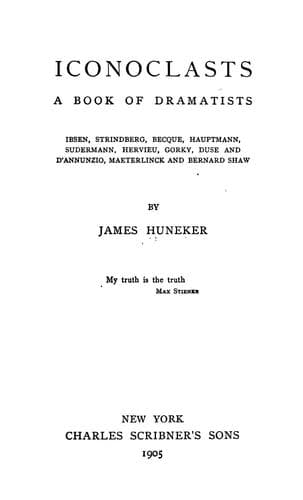
Iconoclasts: A Book of Dramatists: Ibsen, Strindberg, Becque, Hauptmann, Sudermann, Hervieu, Gorky, Duse and D'Annunzio, Maeterlinck and Bernard ShawHuneker, James
History
Iconoclasts: A Book of Dramatists: Ibsen, Strindberg, Becque, Hauptmann, Sudermann, Hervieu, Gorky, Duse and D'Annunzio, Maeterlinck and Bernard Shaw
Huneker, James
Dramatists; European drama -- 19th century -- History and criticism; European drama -- 20th century -- History and criticism
And was not the greatest mystic of all one who saw the image in the
fiery bush, one who, "in the midway of this our mortal life," found
himself in a gloomy wood astray--was not Dante a supreme symbolist?
Life for a man of Maeterlinck's temperament is ever a "forest of
numbers"; with its strange arithmetic he hallucinates himself.
What is The Intruder but a symbol, and one that has enchained the
attention of man from before the time when the Brachycephalic and
the Dolichocephalic waged war with the cave-bear and murder was
celebrated in tribal lays? Through the ages Death, either as a shadowy
obstruction or a skeleton with scythe and hour-glass, has marched ahead
of men. Epic and anecdote, canvas and composition, have celebrated
his ineluctable victories. Why then call Maeterlinck morbid for
embroidering the _macabre_, fascinating theme with new variations!
Death the Intruder! Always the Intruder. In his first little dramatic
_plaque_, it is the venerable grandfather who is clairvoyant: Death,
protagonist. Almost imperceptibly the shadow steals into the room
with the lighted lamp and big Dutch clock. The spiritual evidence is
cumulative; a series of cunningly worded affirmations, and lo! Death
the Intruder. It is a revelation of the technic of atmosphere. Voice
again is the chief character.
The Blind takes us out of doors, though one senses the atmosphere of
the charnel-house under the blue bowl of the unvarying sky. This is
the most familiar and the most derided of the Maeterlinckian plays. It
is hardly necessary to describe that "ancient Nordland forest," with
its "eternal look under a sky of deep stars." The stage directions of
these poems are matchless. How depict an "eternal look"? These exalted
pictures are but the verbal instrumentation of Maeterlinck's motives.
They may be imagined, never realized. Yet how the settings enhance the
theme! These blind old men and women, with the lame, the halt, the mad
and the sad, form a painful tableau in the centre of which sits the
dead priest, their keeper, their leader, without whom they are destined
to stumble into the slow waters about the island.
Death the Intruder! But in this instance an intruder who has sneaked in
unperceived. The discovery is made in semi-tones that mount solemnly
to the apex of a pyramid of woe. This little drama is more "arranged"
than The Intruder; it does not "happen" so inevitably. Interior, called
Home by the English translator, the lamented poet Richard Hovey, is
of similar _genre_ to The Intruder. From a coign in an old garden
planted with willows we see a window--a symbol; through this window
the family may be viewed. Its members are seated. All is vague, dreamy.
The dialogue occurs without. An old man and a stranger discuss the
garden, the family and--the catastrophe. Most skilfully the poet
marshals his facts--hints, pauses, sighs, are the actors in the curious
puppet-booth. One phrase occurs that is the purest Maeterlinck:--
Public-domain text, read in full here on John Shaqi.
Reviews
Reviews
No reviews yet
Be the first to share your thoughts on this work.
Elsewhere in the archive
Join the Discussion
Join the discussion
Sign in to leave a comment or review.
Sign InorCreate an account