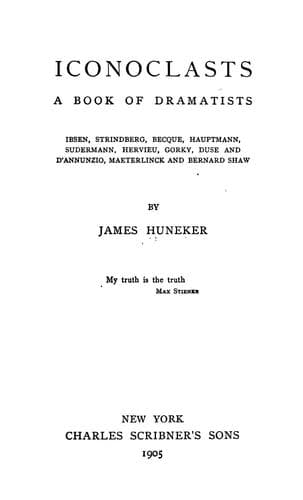
Iconoclasts: A Book of Dramatists: Ibsen, Strindberg, Becque, Hauptmann, Sudermann, Hervieu, Gorky, Duse and D'Annunzio, Maeterlinck and Bernard ShawHuneker, James
History
Iconoclasts: A Book of Dramatists: Ibsen, Strindberg, Becque, Hauptmann, Sudermann, Hervieu, Gorky, Duse and D'Annunzio, Maeterlinck and Bernard Shaw
Huneker, James
Dramatists; European drama -- 19th century -- History and criticism; European drama -- 20th century -- History and criticism
The Prince, after trying to force the window, goes through a secret
passage and reaches the sleepers. The action is supplied by the Queen
at the window above. She weeps, she beats the glass, she says frantic
things in the gloom to the old King. "Seven little open mouths!...
Oh, I am sure they are thirsty," she cries. The Prince awakens the
Princesses--all save one. Ursula lies singularly still. "She is not
asleep! She is not asleep!" screams the frantic Queen. There is a
hurrying to and fro of servitors with torches. "Open, open," is the
piteous plaint of the old woman. Beyond, in the night, is heard the
chant of the seamen as they fade away into the darkness. "The Atlantic,
the Atlantic, we shall return no more."
What does it all mean? What is the hidden symbol? The scene suggests
Holland; yet it is no man's land. These dolorous people with burning
eyes and agitated, feverish gestures--who are they? Poets all.
Despite the decoration, despite the skilful handling of the element
of suspense, this little fantasy is not for the footlights. It is too
literary. There is mastery revealed in the dialogue. The entire piece
recalls a wan Burne-Jones picture with the symphonic accompaniment of
Claude Debussy.
Perhaps it is well that a dramatist is more chained to the planet
than his brethren, the poet, composer, _prosateur_. Like the sculptor
and the architect, the dramatic poet must deal with forms that can
be apprehended by the world. All art is a convention in the last
analysis; theatrical art contains more conventions than the rest. Men
of an original cast of mind revolt at the checks imposed upon their
imagination by the theatre. But Shakespeare submitted to them and, a
lesser man, Maeterlinck, has had to suffer the pangs of defeat. But he
has left his imprint upon the page of the French drama in his disregard
of the stage carpentry of Scribe and Sardou. Above all, he has imparted
to the contemporaneous theatre new poetic ideas. A new technic--on the
material side--is of less importance than the introduction of new modes
of expression, of atmosphere, of ideas.
Public-domain text, read in full here on John Shaqi.
Reviews
Reviews
No reviews yet
Be the first to share your thoughts on this work.
Elsewhere in the archive
Join the Discussion
Join the discussion
Sign in to leave a comment or review.
Sign InorCreate an account