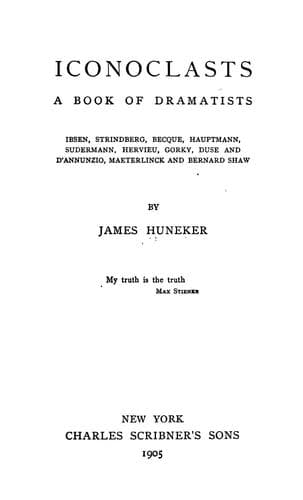
Iconoclasts: A Book of Dramatists: Ibsen, Strindberg, Becque, Hauptmann, Sudermann, Hervieu, Gorky, Duse and D'Annunzio, Maeterlinck and Bernard ShawHuneker, James
History
Iconoclasts: A Book of Dramatists: Ibsen, Strindberg, Becque, Hauptmann, Sudermann, Hervieu, Gorky, Duse and D'Annunzio, Maeterlinck and Bernard Shaw
Huneker, James
Dramatists; European drama -- 19th century -- History and criticism; European drama -- 20th century -- History and criticism
Maeterlinck, after his early essays in a domain that is more poetical
than dramatic, we find longing for the romantic. He tires of single
figures painted upon a small canvas. (Faguet once called him the
"Henner of literature.") He longs for more space, more characters, more
action--in a word--variety. We get it in his next attempt, Alladine
and Palomides. In it there is less music, but more action--withal,
it is naïvely childish. Alladine is loved by Ablamore. He is an old
king, reigning over a castle surrounded by crazy moats. His beloved
is very young. When the knightly Palomides appears, they mutually
love. The King is a philosopher. Listen: "Now I have recognized that
misfortune itself is of better worth than sleep, and that there must
be a life more active and higher than waiting...." There is an avenue
of fountains that unfolds before the windows--wonderful, weariless.
Ablamore interrogates Alladine after she has encountered Palomides.
Does she regard the weariless fountains alone? He soon lays bare the
child soul of this maiden. Ablamore wishes Palomides to marry his
daughter Astolaine. He goes mad with jealousy and casts the lovers
into a dungeon, a trick dungeon, where marvels occur: a sea that is a
sky, move-less flowers. The pair embrace. Death is nigh--"there is
no kissing twice upon the heart of death." Finally they are engulfed.
Rescued, they die in separate chambers of the palace, from which the
aged King has fled. Voices are the only actors in the last scene.
Mediæval, too, in its picturesque quality is The Death of Tintagiles
with its five short acts of despairing sister love. The little
Tintagiles is the king that is to be. His grandmother, a demented
old woman, suffers from a mania which takes the form of aggressive
jealousy. She is ancient on her throne--in what strange land does she
reign?--and she seeks to assassinate the poor little boy. Ygraine
and Bellangère, his sisters, thwart her desires for a time--but
only for a short time. He is eventually kidnapped and murdered. This
simple, old-world fairy story--all Maeterlinck has a tang of the
supernatural--is treated exquisitely. The arousing of pity for the
doomed child is almost Shakespearian. These children of Maeterlinck
are his own creation. No one, with the exception of Dostoïevsky and
Hauptmann, approaches him in unfolding the artless secrets of the
childish heart. Like plucked petals of a white virginal flower, the
little soul is exposed. And there is no taint of precocious sexuality
as in Dostoïevsky's studies of childhood (Les Précoces and others).
Hauptmann's Hannele, among modern figures of girlhood, alone matches
the Belgian. Hannele is nearer the soil than Tintagiles or the little
Yniold.
Public-domain text, read in full here on John Shaqi.
Reviews
Reviews
No reviews yet
Be the first to share your thoughts on this work.
Elsewhere in the archive
Join the Discussion
Join the discussion
Sign in to leave a comment or review.
Sign InorCreate an account