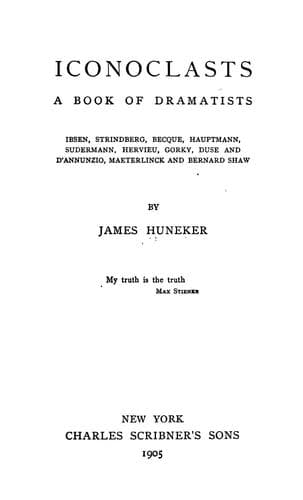
Iconoclasts: A Book of Dramatists: Ibsen, Strindberg, Becque, Hauptmann, Sudermann, Hervieu, Gorky, Duse and D'Annunzio, Maeterlinck and Bernard ShawHuneker, James
History
Iconoclasts: A Book of Dramatists: Ibsen, Strindberg, Becque, Hauptmann, Sudermann, Hervieu, Gorky, Duse and D'Annunzio, Maeterlinck and Bernard Shaw
Huneker, James
Dramatists; European drama -- 19th century -- History and criticism; European drama -- 20th century -- History and criticism
I confess that the condensed bitterness and woe and cruelty of this
last act border on the pathologic if we do not consider the symbol.
I would rather hear the beautiful symphonic poem of Charles Martin
Loeffler based upon the poetic impressions of this piece--the art of
music gives us the "pathos of distance." Yet Maeterlinck's Death of
Tintagiles is in form and style far above his previous efforts. His
marionettes are beginning to modulate into flesh and blood, and, like
the mermaid of the fairy story, the transformation is a painful one.
We note this modulation particularly in Pelléas and Mélisande. First
played in English by Forbes Robertson and Mrs. Patrick Campbell, the
play made a mixed impression in London; though it may be confessed
that, despite the scenic splendour, the translation and the acting
transposed to a lower, realistic key this lovely drama of souls.
There is no play of Maeterlinck's so saturated in poesy, so replete
with romance. The romantic in Maeterlinck has here full sway. There
are episodes as intense as the second act of Tristan and Isolde. One
expects to hear King Marke's distant, tremulous hunting horns in the
forest scene of the fourth act, where Pelléas and Mélisande uncover
their secret.
The plot is not a densely woven one. In the woods while hunting in
a land east of the sun and west of the moon, Golaud, a king's son,
comes upon Mélisande sitting disconsolate at the brink of a spring.
She is timid and would flee. Something has happened to her which she
does not explain, perhaps remember. She is lost, she declares, with
the passionate iteration which has become a fixed pattern in the
Maeterlinck dialogue. She has dropped into the pool the gold crown some
one gave her--who it was she never tells. A forlorn little princess out
of a Hans Christian Andersen fairy tale. Golaud marries her offhand
and brings her to his home, the castle of his grandfather, Arkël, King
of Allemonde. There his father lies dying--we never see this shadowy
invalid--and his brother Pelléas lives. Also Little Yniold, son of
Golaud, by a former marriage. The castle is malarial, rickety, like
many of Maeterlinck's buildings. Nearly all his people seem to suffer
from swampy emanations or the mephitic gas of ancient dungeons. The
evil odours of Arkël's abode are even alluded to in this play.
Public-domain text, read in full here on John Shaqi.
Reviews
Reviews
No reviews yet
Be the first to share your thoughts on this work.
Elsewhere in the archive
Join the Discussion
Join the discussion
Sign in to leave a comment or review.
Sign InorCreate an account