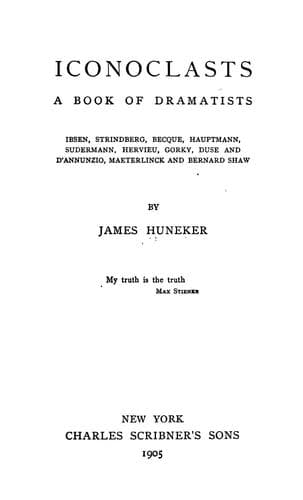
Iconoclasts: A Book of Dramatists: Ibsen, Strindberg, Becque, Hauptmann, Sudermann, Hervieu, Gorky, Duse and D'Annunzio, Maeterlinck and Bernard ShawHuneker, James
History
Iconoclasts: A Book of Dramatists: Ibsen, Strindberg, Becque, Hauptmann, Sudermann, Hervieu, Gorky, Duse and D'Annunzio, Maeterlinck and Bernard Shaw
Huneker, James
Dramatists; European drama -- 19th century -- History and criticism; European drama -- 20th century -- History and criticism
Pelléas and Mélisande love. Golaud suspects it, and his jealousy,
mixing with his love for brother and wife, is delineated masterfully.
We now begin to see the fruits of the dramatist's careful study of
moods. Evanescent as are the moods of the previous plays, they served
as spiritual gymnastics. With them he proved his ability to portray
the finer shades of terror, remorse, love, despair. In the jealousy of
Golaud he takes a step nearer the concrete. Golaud is a hunter, a man
whose temples are touched by gray. He adores his child-wife and trusts
her. He begs the moody Pelléas to wait upon her. His marriage with her
has surprised all, save his grandfather. Arkël says:--
"He has done what he probably must have done. I am very old, and
nevertheless I have not yet seen clearly for one moment into myself;
how would you that I judge what others have done?" A wonderful man,
indeed. Pelléas wishes to visit his dying friend Marcellus--the
Shakespeare nomenclature persists--but Arkël begs him to stay at home,
where death approaches.
Mélisande is well received by the King and Queen. She is astonished at
the gloom of the gardens, and is pleased with the spectacle of the sea.
In the ending of Act I we get a faint premonition of disaster. Pelléas
and Mélisande watch the departure of the ship that brought Mélisande.
(Maeterlinck here borrows an early effect from The Seven Princesses.)
It flies away under full sail.
_Pelléas_. Nothing can be seen any longer on the sea....
_Mélisande_. I see more lights.
_Pelléas_. It is the other lighthouses.... Do you hear the sea? It is
the wind rising. Let us go down this way. Will you give me your hand?
_Mélisande_. See, see, my hands are full.
_Pelléas_, I will hold you by the arm; the road is steep and it is very
gloomy there.... I am going away, perhaps, to-morrow....
_Mélisande_. Oh! ... Why do you go away?
[_Curtain_.
Much sport has been made of the first scene in this play. Yet it
only displays the poet's worship of Shakespeare. Maid-servants are
discovered at the castle gate. They gabble as they knock for admission.
It is as prosaic as the rest of the work is poetic. A porter of the
"Anon, anon, I come" type holds parley. He is borrowed from Macbeth.
However, it does not demand a close reading of this episode to discover
that it sounds the keynote to music--always symbolical--of the drama
that follows.
IV
Public-domain text, read in full here on John Shaqi.
Reviews
Reviews
No reviews yet
Be the first to share your thoughts on this work.
Elsewhere in the archive
Join the Discussion
Join the discussion
Sign in to leave a comment or review.
Sign InorCreate an account