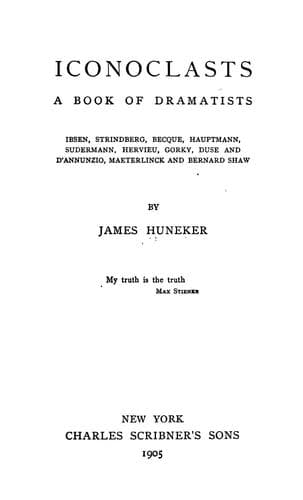
Iconoclasts: A Book of Dramatists: Ibsen, Strindberg, Becque, Hauptmann, Sudermann, Hervieu, Gorky, Duse and D'Annunzio, Maeterlinck and Bernard ShawHuneker, James
History
Iconoclasts: A Book of Dramatists: Ibsen, Strindberg, Becque, Hauptmann, Sudermann, Hervieu, Gorky, Duse and D'Annunzio, Maeterlinck and Bernard Shaw
Huneker, James
Dramatists; European drama -- 19th century -- History and criticism; European drama -- 20th century -- History and criticism
The changes to be rung on such a theme are not a few. But Maeterlinck
has elected to introduce a new and more disturbing element. It is
Arielle, the subconscious nature of Merlin, who always warns him of
impending danger. Instead of the old-fashioned soliloquy, we are given,
because of this dualism, dialogues between Merlin and his subliminal
self. This sounds terribly metaphysical, but as treated by Maeterlinck
Merlin's _alter ego_--his _doppelgänger_, as the German mystics have
it--is a charming young woman attired in gray and purple, minor in key.
If she is his constant mentor, he has also the power of projecting her
into the visible world--materializing, the spiritualists call it; and
as Klingsor tempted Parsifal by transforming Kundry into a seductive
shape, so Merlin uses Arielle as an agent of temptation against his
son, his weak and handsome Lanceor.
The plot is slight. Love, a very passionate, earthly love, is the
theme. Doubtless Maeterlinck intends the entire _conte_ as a symbol;
theatre-goers will be more interested in its external garb. Briefly,
Merlin interrogates the sleeping Arielle and learns that his son
Lanceor, who has just arrived on the island, is at the crisis of his
life. "Le destin de ton fils est inscrit tout entier dans un cercle
d'amour." He is condemned by the Fates to die within the month if he
does not find a perfect love, and to this love all is permitted, even
crime. If the girl upon whom he casts his eyes will sacrifice all
for her love, then happiness will be his portion. We are plunged into
a fairy land at the first words of Merlin. This gift of evoking an
atmosphere in a few phrases is Maeterlinck's own. All resemblance to
Shakespeare's folk vanishes as the scheme is unfolded. At first we see
Merlin addressing Arielle. When she sleeps he loses his force and so he
awakens her. After learning Lanceor's destiny, he resolves to be on his
guard. Joyzelle is cast up by the sea, and, encountering Lanceor, the
inflammable pair fall madly in love with each other. Nothing can come
between, or if any one does--! Lanceor is more assured than Joyzelle
that this is his first, his perfect passion. But Merlin, who pretends
anger, as does Prospero, resolves to test the newly kindled flame. He
threatens to kill Joyzelle if she meets Lanceor, but she defies him,
and refuses to bind herself to any promise imposed upon her. To a
sonorous and emphatic _Non_! the curtain intervenes.
Public-domain text, read in full here on John Shaqi.
Reviews
Reviews
No reviews yet
Be the first to share your thoughts on this work.
Elsewhere in the archive
Join the Discussion
Join the discussion
Sign in to leave a comment or review.
Sign InorCreate an account