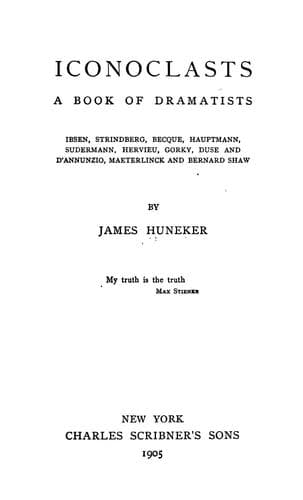
Iconoclasts: A Book of Dramatists: Ibsen, Strindberg, Becque, Hauptmann, Sudermann, Hervieu, Gorky, Duse and D'Annunzio, Maeterlinck and Bernard ShawHuneker, James
History
Iconoclasts: A Book of Dramatists: Ibsen, Strindberg, Becque, Hauptmann, Sudermann, Hervieu, Gorky, Duse and D'Annunzio, Maeterlinck and Bernard Shaw
Huneker, James
Dramatists; European drama -- 19th century -- History and criticism; European drama -- 20th century -- History and criticism
However, there it stood, this _affiche_; and there it stood the night
I stumbled through the semi-obscurity of the well-known house to my
_loge._ The criticisms of the new play had not been reassuring; a
second Monna Vanna was not to be expected; a return to Maeterlinck's
earlier manner was unthinkable, so I confess that I awaited the parting
of the curtains with a fair amount of curiosity. I was not disappointed
when the first scene disclosed a _loggia_ of a Renascence _palazzo_.
This setting sounded the keynote--and a very beautiful, delicate note
it was, for the author has been as careful in the mounting of this
play as he was indifferent in his first essays. Signor Rovescalli of
Milan had carried out the designs of Charles Doudelet with fidelity
and taste. The Pinturicchio costumes are all from the same hands.
Nothing--except the lighting--has been omitted that might add to
the incarnation of this dream--for a dream play Joyzelle is, full of
strange hypnotic action and phrases that haunt.
The piece, which is called a Conte d'Amour, is in five short acts. It
is confined to four characters, two of which carry the slight thread
of story. In style it is midway between Maeterlinck's earlier manner
and Monna Vanna. It might, if considered in historic sequence, have
been written before Monna Vanna, and thus could have furnished the
link between the static and the dynamic theatre of this poet. Coming
after the Italian tragedy of hot blood, it seems like a casting back
to an earlier manner. But it is not. There is more action than in any
play,--Vanna excepted,--more than in Pelléas and Mélisande. There
are passion and climax that come perilously nearer theatricalism than
anything Maeterlinck has yet written, though he steers around the
banal, avoiding it by a hair-breadth. Admirers of the dramatist's
repressed style must have taken a deep breath as the episode of the
attempted assassination developed into something quite unexpected.
Joyzelle is little more than a series of situations, in which the
heroine is tested by the stern old enchanter Merlin. When I called upon
the poet at his picturesque little house in Passy, I asked him about
The Tempest, which the critics one and all saw in his play. He smiled
and replied that Shakespeare was a good point of departure. Could
there be a better one? The resemblance is rather superficial. Prospero
and Miranda are, in the mysterious island of Maeterlinck, Merlin and
Lanceor--the latter the magician's son; and Joyzelle is, if you will, a
female Ferdinand come to woo the youth.
Public-domain text, read in full here on John Shaqi.
Reviews
Reviews
No reviews yet
Be the first to share your thoughts on this work.
Elsewhere in the archive
Join the Discussion
Join the discussion
Sign in to leave a comment or review.
Sign InorCreate an account