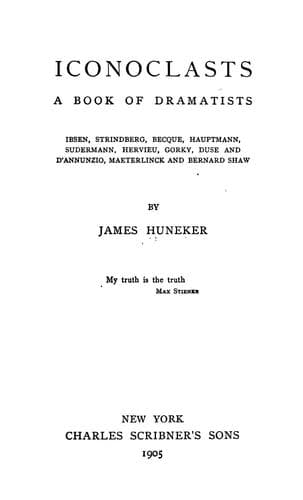
Iconoclasts: A Book of Dramatists: Ibsen, Strindberg, Becque, Hauptmann, Sudermann, Hervieu, Gorky, Duse and D'Annunzio, Maeterlinck and Bernard ShawHuneker, James
History
Iconoclasts: A Book of Dramatists: Ibsen, Strindberg, Becque, Hauptmann, Sudermann, Hervieu, Gorky, Duse and D'Annunzio, Maeterlinck and Bernard Shaw
Huneker, James
Dramatists; European drama -- 19th century -- History and criticism; European drama -- 20th century -- History and criticism
How to extricate the girl from her grave position? Lanceor's good looks
have been spoiled by his illness--a mere trifle for this insatiable
creature. In the last act Merlin lies sleeping, Arielle on guard.
Joyzelle approaches, her face set in despair, yet firm in her purpose
to fulfil her destiny. She has promised. Lanceor has been saved. She
will pay. As she reaches the couch of the magician she plucks forth a
dagger and would have bloody murder. This is the supreme test--rather a
disquieting doctrine to the passivists and gentle persons who feed on
Maeterlinck's balmy philosophies. Love that does not flinch at crime
is the keystone to this little arch of a play. Merlin is satisfied.
Joyzelle has undergone his tests. She is the perfect woman for
Lanceor's perfect love. The two are united, and the lovely landscape
fades from our view like the misty pictures in a Chopin Ballade.
Ideal love is the motive of this new play, love that will march to the
jaws of hell, if needs be, for the beloved one; Orpheus and Eurydice,
Hero and Leander, or any other enamoured couple come to your memory as
the ingenuous Joyzelle, who has not a faint trace of humour in her,
proceeds gravely to the unpleasant tasks set her by Merlin. I could
not help recalling that Princess Istar,--set to music by d'Indy,--who
goes down into Hades and at each of its seven gates casts away a part
of her belongings. At the seventh and last gate she has remaining only
her nakedness. Maeterlinck removes leaf after leaf from the flower-like
soul of Joyzelle until its very core is reached.
While she bears a sisterly resemblance to many of his narve infantile
women, she is nearer related to Monna Vanna in her affirmative nature.
She is very full-blooded for a dream maiden, and at times she showed
something of Sardou's tigress-like creatures. Possibly one received
this impression because Georgette Leblanc, who originated the title
rôle, has evidently been a close student of Sarah Bernhardt's methods.
As is the case with modern _féministe_ writers--were there ever ancient
ones?--the woman is enthroned, she is the Eternal Womanly, and she has
the final word in the destiny of things, as in Goethe's poem. Lanceor
does not appear in an undesirable light, while Merlin represents Wisdom
and makes very Maeterlinckian speeches. His final words are full of the
sober dignity we expect from the author of Wisdom and Destiny.
In Joyzelle the words count for something, no matter what the author
intends them to convey by the "second intention." He once wrote "Les
hommes out je ne sais quelle peur étrange de la beauté." This strange
fear the young Belgian Merlin evokes of his own accord. We sense
the beauty, but are uncomfortable in its presence. Human beings or
semi-humans must act to reveal themselves. This they do in Joyzelle.
There can be no reproach here of the abuse of the "static," only the
action and words--couched in harmonious prose--do not quite summon
reality to us.
Public-domain text, read in full here on John Shaqi.
Reviews
Reviews
No reviews yet
Be the first to share your thoughts on this work.
Elsewhere in the archive
Join the Discussion
Join the discussion
Sign in to leave a comment or review.
Sign InorCreate an account