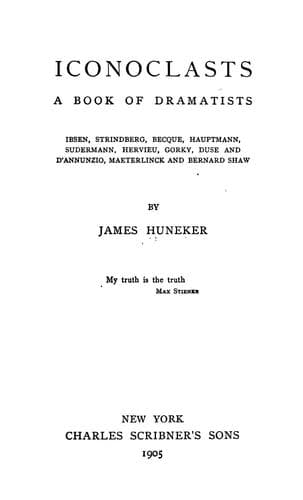
Iconoclasts: A Book of Dramatists: Ibsen, Strindberg, Becque, Hauptmann, Sudermann, Hervieu, Gorky, Duse and D'Annunzio, Maeterlinck and Bernard ShawHuneker, James
History
Iconoclasts: A Book of Dramatists: Ibsen, Strindberg, Becque, Hauptmann, Sudermann, Hervieu, Gorky, Duse and D'Annunzio, Maeterlinck and Bernard Shaw
Huneker, James
Dramatists; European drama -- 19th century -- History and criticism; European drama -- 20th century -- History and criticism
The disembodied thoughts of the poet are given a local habitation and
a name, and still they remain thoughts, abstractions; they are not of
our flesh and blood, but seem to inhabit that "Third Kingdom" Ibsen
has foretold. More "interior" than Monna Vanna, Joyzelle is hardly
apt to be appreciated. I feel quite sure that many of the adjectives
lavished upon it by the Parisian press were not sincere. As a race the
French cannot be in sympathy with the gray, slow, poetic images of this
Belgian mystic.
I had read Walkley's capital book on Dramatic Criticism, and after the
performance of Joyzelle I opened its pages and saw this: "So, says
Coleridge, stage presentations are to produce a sort of temporary half
faith, which the spectator encourages in himself and supports by a
voluntary contribution on his own part, because he knows that it is at
all times in his power to see the thing as it really is. Thus the true
stage illusion as to a forest scene consists--not in the mind's judging
it to be a forest, but in its remission of the judgment that it is not
a forest."
Joyzelle, then, would be the negation of the drama did we not allow for
Coleridge's "remission." If we can shut our eyes to the pure idealism
of Arielle, and see, as the poet intends us to do, a little love tale,
our enjoyment would be materially heightened. Theories hamper; so does
criticism. And the unhappiest critic of the drama is he who approaches
his author consciously. As in music, so in much of the Maeterlinckian
drama, nothing happens, and if we could be content to abandon ourselves
on the waves of the dramatist's fantasy, our pleasure would be tenfold
enhanced. This is the attitude in which one receives music. Why not
adopt its receptivity in Maeterlinck's case? for his plays are as near
the inarticulateness of music as they dare to be and still retain sober
lineaments.
Public-domain text, read in full here on John Shaqi.
Reviews
Reviews
No reviews yet
Be the first to share your thoughts on this work.
Elsewhere in the archive
Join the Discussion
Join the discussion
Sign in to leave a comment or review.
Sign InorCreate an account