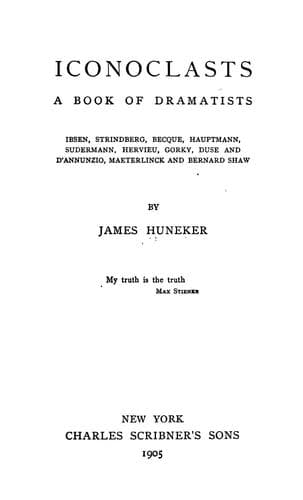
Iconoclasts: A Book of Dramatists: Ibsen, Strindberg, Becque, Hauptmann, Sudermann, Hervieu, Gorky, Duse and D'Annunzio, Maeterlinck and Bernard ShawHuneker, James
History
Iconoclasts: A Book of Dramatists: Ibsen, Strindberg, Becque, Hauptmann, Sudermann, Hervieu, Gorky, Duse and D'Annunzio, Maeterlinck and Bernard Shaw
Huneker, James
Dramatists; European drama -- 19th century -- History and criticism; European drama -- 20th century -- History and criticism
Experience of a saddening sort taught me that a man and his works
are twain; that a poet never looks like a poet; a composer is seldom
harmonious in private life. Yet I could not be but tempted when a
brief, courteous note from the author of Monna Vanna informed me that
he would give me an evening hour for an informal interview. Maeterlinck
lives on the Rue Reynouard in a small house, the garden of which
overlooks the Seine from the moderate heights of Passy. To reach his
apartments I had to traverse a twisted courtyard, several mysterious
staircases built on the corkscrew model, and finally was ushered into
an ante-chamber full of screens, old engravings, fans, much ornamental
brass, and reproductions of Mantegna, Rossetti, Burne-Jones, and other
symbolistic painters.
But I was not to abide there long. A maid with doubting eyes piloted
me across a narrow hallway, through a room where sat a tirewoman
altering theatrical costumes--and at last I was not in M. Maeterlinck's
presence. Not yet. Down another staircase, and the great man loomed
up in cycling costume, cordial, grave, a handsome fellow with big,
Flemish bones, a small, round head, and wavy hair dappling at the
temples. A man past forty, a gentle, pensive sort of man, Maurice
Maeterlinck does not look like his photographs for the reason that they
were taken nearly a decade ago. He is much older, much more vigorous,
than I pictured him. The general race characteristics are Flemish or
Belgian--that is, Germanic and not Gallic. This he knows well and
realizes that his work must ever be exotic to the logical mind of the
Frenchman, for whom the form is ever paramount to the idea.
Maeterlinck's eyes are what the French call flowers of the head. A gray
blue, with hints of green, they are melancholy eyes, these, with long,
dark lashes. He is extremely modest, even diffident, though touch him
on his favourite theme and he responds readily. A devourer of English
literature, he will not venture into conversation in our tongue, for
he has had little practice. German he speaks, and he knows Italian. He
told me that in composing Monna Vanna, he read Sismondi for a year so
as to get historical colour. He was quite frank about the conception of
this play.
"I wrote it for Mme. Maeterlinck," he remarked simply, which disposed
of my theory that the piece was written to prove he knew how to make a
drama on conventional lines. Joyzelle was also written for the same
actress, a woman who has played an important rôle in the poet's life.
Then I brought up Browning's Luria and the opinion of Professor Phelps
of Yale that Maeterlinck had profited by reading the English poet when
he composed Monna Vanna. M. Maeterlinck smiled.
Public-domain text, read in full here on John Shaqi.
Reviews
Reviews
No reviews yet
Be the first to share your thoughts on this work.
Elsewhere in the archive
Join the Discussion
Join the discussion
Sign in to leave a comment or review.
Sign InorCreate an account