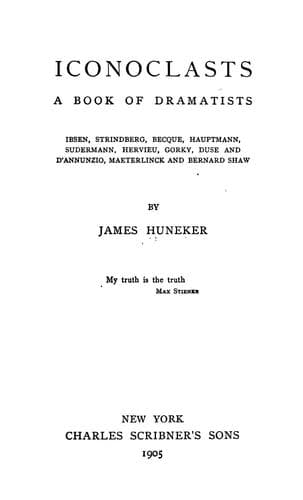
Iconoclasts: A Book of Dramatists: Ibsen, Strindberg, Becque, Hauptmann, Sudermann, Hervieu, Gorky, Duse and D'Annunzio, Maeterlinck and Bernard ShawHuneker, James
History
Iconoclasts: A Book of Dramatists: Ibsen, Strindberg, Becque, Hauptmann, Sudermann, Hervieu, Gorky, Duse and D'Annunzio, Maeterlinck and Bernard Shaw
Huneker, James
Dramatists; European drama -- 19th century -- History and criticism; European drama -- 20th century -- History and criticism
"Naturally I read Browning; who does not?" he said, with the naïve
intonation that becomes him so well. "Luria I have known for a long
time, but Luria is not a stage play;" which, coming from the author of
Les Aveugles, I considered sublime. He is quite right--Monna Vanna and
Luria have little in common except that the scenes of both are laid
at Pisa, and that both Luria and Prinzevalle were treated badly by an
ungrateful country. But then, so was Coriolanus and a host of other
historical patriots. Maeterlinck spoke of Shakespeare as other men
mention their deity. He knows Poe very well, and also Walt Whitman.
A study of Maeterlinck's art reveals the evolution of a mystic, the
creation of a dream theatre, the master of a mystic positivism.
In Edgar Quinet's romance, Merlin, we read of a visit made by the
magician to Prester John at his abbey. This abbey is an astounding
conglomeration of architectures--pagoda, mosque, basilica, Greek
temple, synagogue, cathedral, Byzantine and Gothic chapels, turrets,
minarets, and towers in bewildering array. Prester John is a venerable
man with a long, white beard. "Upon his head he wore a turban enriched
with a sapphire cross At his neck hung a golden crescent, and he
supported himself upon a staff after the manner of a Brahman. Three
children followed him, who carried each upon the breast an open book.
The first was the collection of the Vedas, the second was the Bible,
the third the Koran. At certain moments Prester John stopped and read a
few lines from one of the sacred volumes; after which he continued his
walk, his eyes fixed upon the stars."
Maurice Maeterlinck recalls this type of eclectic culture. Eclectic is
his taste in creeds and cultures. And in this he is the true man of
the twentieth century, summing up in himself the depths and shallows,
virtues and defects, of cultured eclecticism.
The greater part of the foregoing essays, now completely revised,
first appeared in the columns of the New York _Sun_ at the time the
author was dramatic editor of that journal. He wishes to acknowledge
here the courtesy of William M. Laffan, Esq. in the matter of their
republication.
Public-domain text, read in full here on John Shaqi.
Reviews
Reviews
No reviews yet
Be the first to share your thoughts on this work.
Elsewhere in the archive
Join the Discussion
Join the discussion
Sign in to leave a comment or review.
Sign InorCreate an account